Tim Mohin: California Amends Climate Laws
For more from Tim Mohin, sign up for his newsletter here
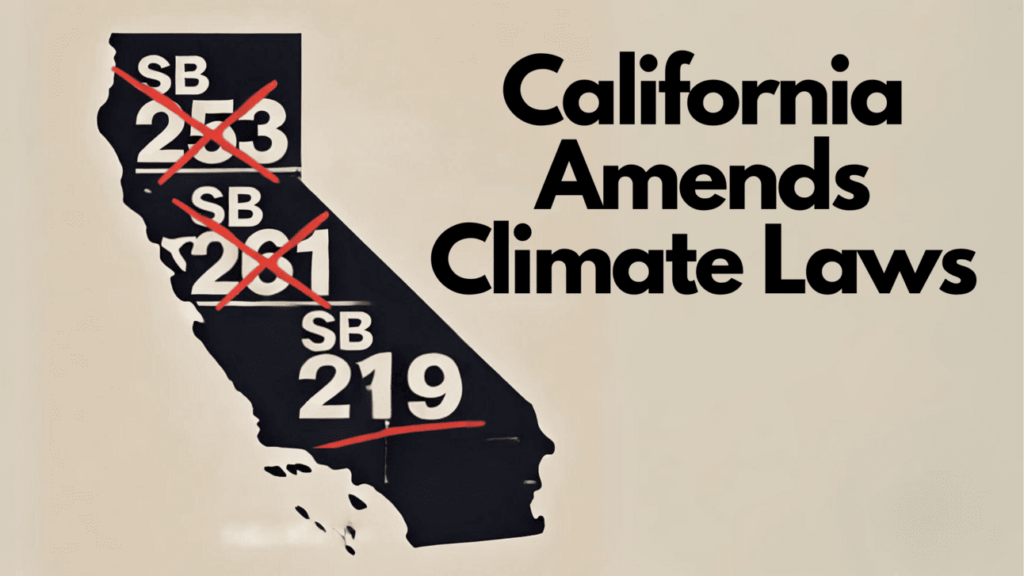
California made headlines in March 2023 when the legislature sent Governor Gavin Newsom three new climate laws. He signed all three into law with a cautionary message that implementing rules and adequate funding would be needed. In the intervening 18 months, the state is still struggling to implement these policies, and this week, the state Senate introduced a possible solution in the form of yet another climate bill: SB 219.
Setting the context: The California “Accountability Package” included three separate bills: SB 253 (Scope 1, 2, and 3 emissions disclosures), SB 261 (climate risk disclosure), and AB 1305 (voluntary carbon market—VCM—disclosures).
In June of this year, Governor Newsom proposed delaying the implementation of the emissions and risk policies (SB 253 and 261) by two years – meaning companies would start reporting in 2028. This was met with some pushback: The architect of SB 253 (emissions disclosure), Senator Scott Weiner, said the “law already has a 6-year phase-in.”AndDave Jones, director of the University of California Berkeley’s Center for Law, said, “There really is no reason for the delay. Both bills have timelines that are attainable.
As the deadline for the California Air Resources Board (CARB) to issue the implementing rules approaches (January 2025), Senator Weiner released an updated, consolidated version of the two bills under SB 219. This bill gives CARB an additional six months to make the rules and keeps the current deadlines for company reports—starting in 2026.
The new bill also allows companies to consolidate their reporting requirements for SB 253 and SB 261 at the parent company level. Additionally, CARB has the option, though not the obligation, to collaborate with an outside organization to produce a climate risk report and to develop a program for making the required disclosures public.
Related Article: Tim Mohin: Investors Rally Behind SEC Climate Rule
To help address concerns about the costs of compliance, SB 219 eliminates the fees companies were expected to pay under SB 253 and SB 261. However, there is no clarification on how these costs will be covered. Given the current state budget deficit, this will be an issue.
Budget negotiations conclude on August 31st, so stay tuned for next week’s newsletter for a more definitive answer on the fate of these important climate policies.
And, we did not forget the often overlooked AB 1305, which requires disclosure of voluntary carbon credits. This bill had the most ambitious timeline, expecting companies that use or sell carbon credits to report on the validity, verification, and progress of those carbon credit projects back in Jan 2024.
In February of this year, AB 1305 was postponed and became the amended AB 2331. The most notable change was delaying the effective date to Jan 1st, 2025. Another change said that “renewable energy certificates issued through an accounting system of a governmental regulatory body” would not be considered part of the voluntary carbon market and are not covered. This exempted carbon trading under California’s regulated emissions trading scheme
On August 23rd, the bill was amended again, pushing the reporting deadline back an additional six months to July 2025. This amended bill has passed through every committee so far resoundingly and is expected to move through the legislative process with ease.

Tim Mohin is weekly smart read contributor to ESG News. Tim is globally recognized sustainable business executive. He is a partner and director for the Boston Consulting Group (BCG) in climate and sustainability.
Prior to BCG, Tim was the EVP and Chief Sustainability Officer with leading carbon accounting software company – Persefoni . He is the former Chief Executive of the Global Reporting Initiative (GRI), the world’s largest sustainability reporting standard.
He brings more than 20 years’ experience leading sustainability functions at three Fortune 500 companies – Intel, Apple and AMD – Tim has deep experience developing strategies to embed sustainability into business. Tim also led the development of environmental policy in the Environmental Protection Agency and the United States Senate, including the Clean Air Act. He is a sustainability advisor to the Financial Conduct Authority of the United Kingdom, the Board of BASF, Workiva and others. Previously, Tim was a founder and Chairman of the Board for the Responsible Business Alliance.
He is the author of Changing Business from the Inside Out and a frequent speaker and writer on sustainability and corporate responsibility. Tim writes a weekly ESG Newsletter, and is one of LinkedIn’s 2022 Top Voices in the Green Economy. He is consistently recognized in the top 20 of Corporate Social Responsibility Influence Leaders.