EFRAG Launches ESRS Knowledge Hub to Centralize Sustainability Reporting Standards
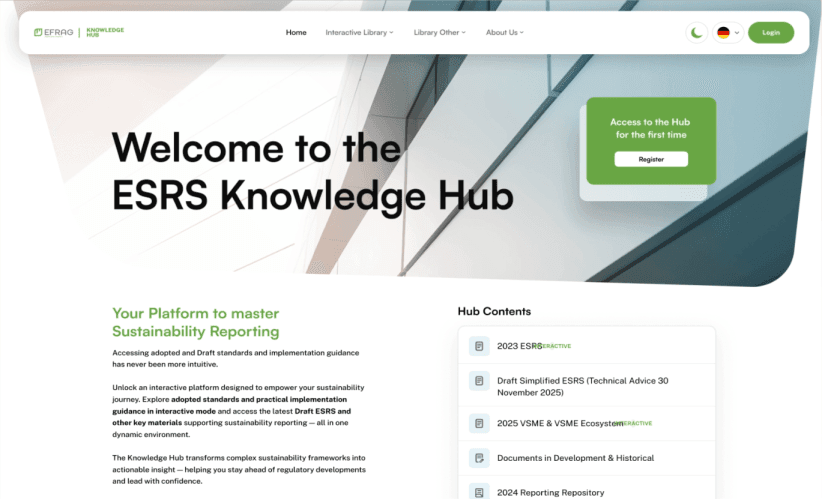
• New ESRS Knowledge Hub integrates 2023 ESRS, simplified ESRS, VSME standards and implementation guidance in a single platform.
• Platform connects reporting resources with EU legislation and international frameworks to support consistent disclosure across markets.
• Launch strengthens transparency, standardisation and usability as European sustainability reporting expands to thousands of companies.
Brussels has introduced a tool that could reshape how global companies navigate European sustainability disclosure rules. EFRAG has launched the ESRS Knowledge Hub, a comprehensive online platform providing direct access to the European Sustainability Reporting Standards and related guidance that companies will rely on as disclosure requirements intensify.
The Hub arrives at a critical moment. Mandatory sustainability reporting is expanding across Europe, and international investors increasingly assess companies against alignment with the Corporate Sustainability Reporting Directive and other regulatory frameworks. EFRAG’s objective is to remove friction, reduce interpretation gaps and give market participants a single, reliable gateway to the rapidly evolving rule set.
Patrick de Cambourg, Chair of the EFRAG Sustainability Reporting Board, stated that the development of the platform responds to a growing need for structure and clarity across markets. In his words, “The launch of the ESRS Knowledge Hub represents a significant milestone in the accessibility and coherence of the sustainability reporting landscape. EFRAG is proud to contribute to the strengthening of this ecosystem by providing a comprehensive, reliable and user-oriented platform that supports consistent implementation of the ESRS and enhances transparency for all stakeholders.”

What the Hub contains
At launch, the platform integrates the adopted 2023 ESRS, the simplified ESRS approved on 28 November 2025, the VSME standard for smaller entities, as well as implementation guidance, supporting documents and historical material. Users can navigate interactively through the 2023 ESRS and the VSME standards, while the same functionality for simplified ESRS will come online following adoption by the European Commission.
Interactivity is not cosmetic. It is built to allow cross-referencing, direct linkage to EU law, and alignment with international standards in ways that most disclosure teams have until now assembled manually. Historical content and external references bring continuity, which matters for auditors and investors assessing year-on-year change rather than static compliance snapshots.
Stakeholders can also monitor ongoing standard-setting activity. Discussions in the EFRAG SRB and EFRAG SR TEG meetings are embedded into the platform, giving users visibility into upcoming decisions before they become binding requirements. For companies planning phased transition strategies, this element could prove as valuable as the existing standards themselves.
RELATED ARTICLE: New EFRAG-GRI MoU Enhances Sustainability Reporting in Europe
Why this matters for governance and finance
For boards and sustainability officers, the Knowledge Hub offers something that has been scarce in the European reporting ecosystem: consolidation. Multinationals have pushed for greater navigability as they work to align climate, human rights, water, biodiversity and value chain disclosure expectations across jurisdictions. Investors have called for consistency to improve comparability and reduce reporting fatigue.
The Hub is designed to meet both needs. It could shorten internal interpretation cycles, lower advisory costs and support faster policy adoption in markets where the CSRD is being transposed into national law. That reduces risk for financial institutions that depend on reported sustainability data when allocating capital or assessing supply chain exposure.
What C-suite and investors should watch
The most immediate takeaway is efficiency. If the Knowledge Hub delivers on its purpose, reporting teams may move more quickly from guidance to application. That in turn strengthens data availability for lenders, asset managers and buyers, especially across value chains that involve thousands of small and medium-sized enterprises.
The second is global reach. While the platform is built for European standards, its structure aligns with a broader shift toward international convergence. Companies reporting under ISSB or following SEC climate disclosure developments will likely monitor the Hub to compare definitions, boundaries and materiality expectations across regions.
The final consideration is strategic. Access to a unified reporting environment can accelerate national adoption and harmonisation, influencing how fast and how consistently sustainability disclosure reshapes financial markets. As European rules gain traction, the availability of a single digital gateway reduces entry barriers for non EU-based companies seeking alignment.
A unified reference point as sustainability reporting scales
EFRAG’s platform is more than a library. It is a tool that brings structure to a reporting landscape that is growing in complexity as sustainability information becomes decision-grade financial data. For corporate leaders, regulators and investors, the Knowledge Hub offers clarity at a moment when clarity is scarce.
The coming year will determine how widely the Hub is adopted and how effectively it improves ESRS implementation across Europe and beyond. With scaling disclosure demands and increasing pressure for comparability, a centralised reference point may play a defining role in shaping the next phase of global sustainability governance.
Follow ESG News on LinkedIn

The ESG News Editorial Team is comprised of veteran financial journalists and sustainability analysts dedicated to providing real-time, objective reporting on global ESG regulations, climate finance, and corporate governance. Our desk monitors daily developments from the SEC, IFRS, CSRD and international regulatory bodies to ensure our 1M+ readers receive accurate, data-driven insights into the evolving sustainable investment landscape. Follow the ESG News Editorial Team for expert reporting on global sustainability standards, ESG disclosures, and climate policy. Access over 10,000 investigative reports and real-time updates.