Sustainable Finance & Market Infrastructure: Abu Dhabi Finance Week Marks a Turning Point for Institutional Digital Assets
Abu Dhabi Finance Week (ADFW) 2025 underscored a structural shift in global financial markets, as digital assets, tokenization, and blockchain-enabled systems move decisively into the institutional mainstream. What was once framed as a speculative or alternative asset class is now being discussed as core financial infrastructure, with direct implications for sustainable finance, capital efficiency, and long-term market resilience. Despite its continued growth, ADFW maintained a high signal-to-noise ratio, reinforcing Abu Dhabi’s role as a jurisdiction capable of scaling global finance conversations without diluting substance.
Digital assets featured prominently across both Asset Management and Fintech tracks, reflecting their transition from niche innovation to foundational market infrastructure. Institutional participants—including family offices, sovereign investors, and asset managers—no longer questioned whether digital assets belong in portfolios. Instead, discussions focused on how regulated digital infrastructure can improve transparency, liquidity, and capital allocation efficiency, all of which are central pillars of sustainable finance.
Demographic change and regulatory clarity are accelerating this transition. Younger generations are increasingly comfortable operating within digital-native financial environments, while jurisdictions such as Abu Dhabi Global Market (ADGM) have provided the regulatory certainty required for institutional participation. At the same time, validation from major global financial institutions has reframed digital assets as a strategic necessity rather than an optional allocation. For sovereign wealth funds managing intergenerational capital, failing to engage with digital-native financial systems is increasingly viewed as a long-term fiduciary risk.
Tokenization emerged as one of the most consequential themes at ADFW, no longer treated as an experimental concept but as a practical evolution of capital markets infrastructure. Institutional focus is shifting toward tokenized equities, fixed income, and on-chain capital markets that enable continuous trading, faster settlement, and improved capital mobility. The growing adoption of stablecoins and regulated custody frameworks is reinforcing institutional confidence, allowing blockchain-based markets to operate within familiar risk, compliance, and governance structures.
While regulatory progress has been significant, institutional knowledge gaps remain the primary constraint on adoption, particularly among mid-sized banks and financial institutions. Many organizations lack internal mandates or specialized expertise to deploy digital asset strategies at scale. However, this gap is closing rapidly as competitive pressure from early movers intensifies. Market participants increasingly expect accelerated hiring, strategic partnerships, and consolidation, with traditional financial institutions acquiring digital infrastructure and capabilities rather than building them internally.
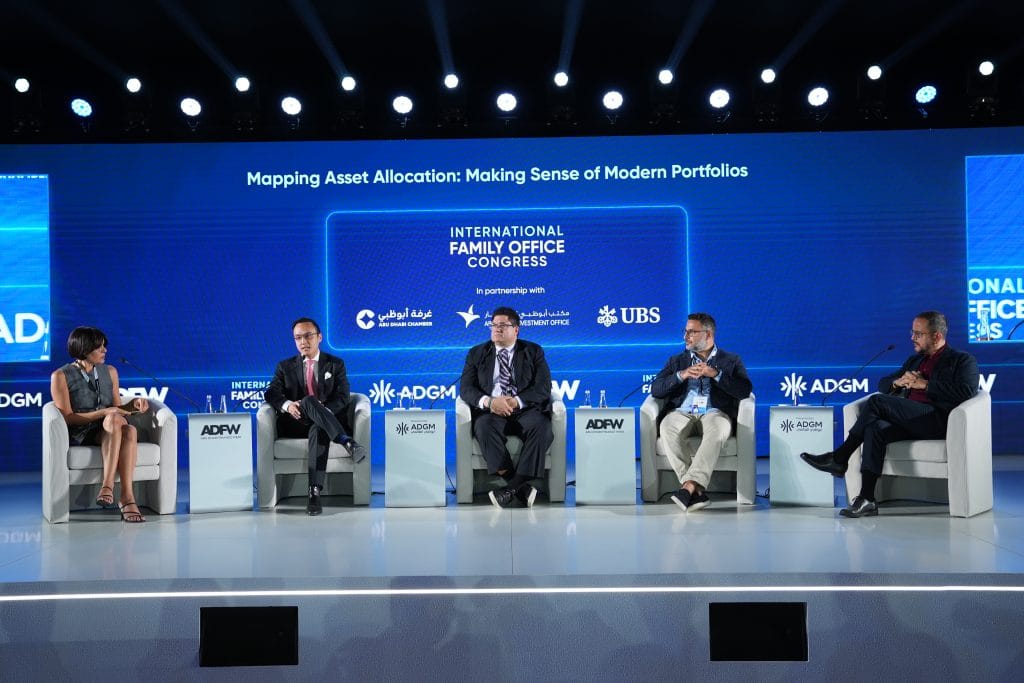
During the ADFW panel “Mapping Asset Allocation: Making Sense of Modern Portfolios,” the discussion highlighted a clear shift in how institutional investors are approaching digital assets—not as speculative outliers, but as components of modern portfolio construction.
Speaking alongside leaders from GROW Investment Group, Akkad Holdings, ESAS Holding and Beacon Hills, XBTO’s Karl Naïm, offered a practitioner’s perspective on how institutional-grade digital infrastructure is converging with traditional investment disciplines.
In a post-event interview, Karl Naïm, Chief Commercial Officer at XBTO, commented: “As digital asset markets mature and volatility compresses over time, firms like ours have been focusing on active strategies designed to generate alpha—mirroring the evolution of traditional hedge fund markets,” Naim said. “Tokenized private debt issuance and increasing demand for Bitcoin yield solutions combined with regulated custody offerings further demonstrate how digital assets are becoming embedded within mainstream capital markets and part of corporate treasury conversations, rather than operating at their margins.”
From a sustainable finance perspective, the implications of this shift are material. Digital market infrastructure enables more efficient capital allocation, broader access to private and emerging assets through tokenization, and reduced friction and settlement risk across financial systems. These structural improvements strengthen market resilience and support longer-term investment horizons aligned with sustainability objectives.
ADFW 2025 reinforced Abu Dhabi’s position as a global hub for sustainable financial infrastructure, combining regulatory certainty, sovereign capital, and long-term policy alignment. As digital assets move from experimentation to execution, Abu Dhabi is increasingly where institutional finance and digital infrastructure converge at scale. For ESG News, the signal is clear: sustainable finance is no longer defined solely by disclosures or frameworks, but by the infrastructure that enables capital to move efficiently, transparently, and globally.
RELATED CONTENT: Abu Dhabi Sustainable Finance Forum Reinforces Abu Dhabi’s Role in Global Climate Finance

The ESG News Editorial Team is comprised of veteran financial journalists and sustainability analysts dedicated to providing real-time, objective reporting on global ESG regulations, climate finance, and corporate governance. Our desk monitors daily developments from the SEC, IFRS, CSRD and international regulatory bodies to ensure our 1M+ readers receive accurate, data-driven insights into the evolving sustainable investment landscape. Follow the ESG News Editorial Team for expert reporting on global sustainability standards, ESG disclosures, and climate policy. Access over 10,000 investigative reports and real-time updates.