
Eight Sustainability Forces Shaping US Businesses in 2026
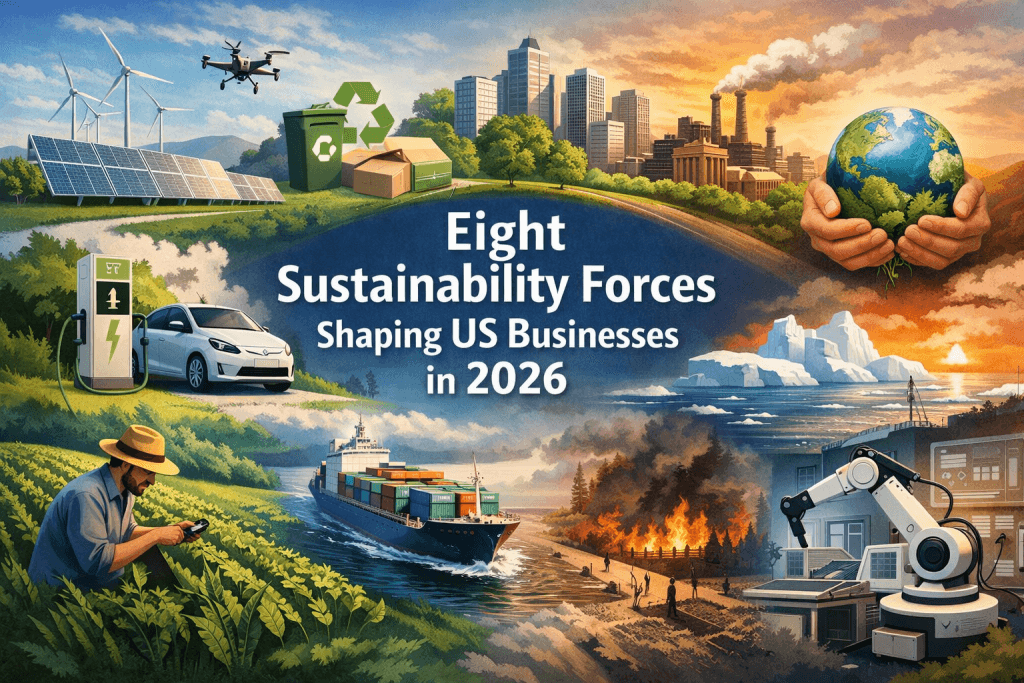
Sustainability may continue to be politically contested in 2026. But, if 2025 proved anything, it was that companies will continue to work on sustainability because it delivers business value.
2026 will be an inflection year: disclosure becomes mandatory for thousands of companies in the US and globally; the supply chain remains a significant source and solution for corporate sustainability challenges; and adaptation is set to have its moment as climate risks hit profits.
Sustainability will become a compliance necessity and a way to differentiate your business in the coming year. Here are eight things businesses can’t ignore.
#1 US sees first mandatory climate disclosure regulation
Starting in 2026, thousands of U.S. companies will be required to disclose climate-related information for the first time. California has passed two climate disclosure laws. While half of the rule (SB 261) is currently under a court-ordered stay, it is expected to be finalized in January. The other emissions reporting component of the rule (SB 253) is finalized and will require covered entities to report their Scope 1 and 2 emissions by August 10th, 2026.
Companies that meet the revenue thresholds for these rules, and are “Doing business in California,” should already be prepared or well on their way to meet the compliance needs of these rules. This is not a test year. Penalties, both fiscal and reputational, are very real, so the best course of action is to comply.
#2 Global regulatory fragmentation
2025 marked a significant reversal in sustainability disclosure across both the U.S. and EU. In the U.S., the SEC withdrew its long-awaited climate disclosure rule early in the year, while in Europe, the Corporate Sustainability Reporting and Due Diligence Directives (CSRD and CS3D) were weakened through the EU’s Omnibus process.
While some jurisdictions are likely to face continued regulatory uncertainty in 2026, others will move firmly into implementation. Nearly a dozen of the 40 countries that have committed to sustainability reporting regulations aligned with the International Sustainability Reporting Standards (ISSB) framework are expected to begin enforcing their rules next year.
And, on January 1st, the world’s first carbon border tariff, the EU’s Carbon Border Adjustment Mechanism (CBAM) kicked in. It means for the first time importers of covered products, like steel, cement, and aluminum, must report the embodied emissions of their imports and pay a tax (~€80 per ton) above an emissions threshold. This will have far-reaching implications for the competitiveness of lower-carbon products.
#3 Scope 3 supply chain pressure continues to build
Many of these rules, including those in China, Hong Kong, and Singapore, will require Scope 3 reporting. Thousands of US companies will also be preparing for Scope 3 reporting under the California Rules in 2027, meaning companies will ask suppliers to share their own emissions data to support compliance.
However, the primary pressure will continue to come from voluntary requests through frameworks such as CDP and EcoVadis. Large multinationals requested sustainability data from more than 100,000 companies through one or both of these channels in 2025, and that number is likely to rise again in 2026. More than 3,000 companies in the US alone did not respond to a CDP data request, and thousands more from EcoVadis and other requests in 2025.
2026 may be the year companies that are not responding begin to lose business or be deprioritized, as large companies increasingly require this information for risk assessments, compliance, and to meet their own goals.
#4 Assurance expectations rise even without legal mandates
While limited assurance is not required for California’s Climate Rules in 2026, it is advised and will become mandatory in 2027. We expect many companies to use this as a dry-run year to obtain limited assurance on their emissions before it becomes a mandate.
In 2025, 81% of global public companies by market cap had third-party assurance for their sustainability reporting. As the number of companies being asked to provide sustainability data by regulators, customers, and other stakeholders increases in 2026, we expect that number to rise for both public and private companies.
Investors seeking accurate climate risk data to inform investment decisions and regulators seeking to verify companies’ claims have made auditability a top priority. Audit-ready emissions data will serve as the baseline in 2026, ahead of limited assurance requirements in 2027 and more robust, reasonable assurances in 2030.
#5 AI as a climate problem and solution
The climate impact of AI was widely publicized in 2025, and while data centers account for only 1.5% of global energy use today, that share is expanding rapidly.
The climate, water, and resource impact of AI chips and data centers is real. However, its potential to automate climate data collection, calculation, and reporting, to speed up R&D cycles, and to improve energy efficiency will likely reduce emissions more than it generates. One study projected that by 2035, AI could reduce annual emissions by 13% relative to today’s levels.
In 2026, expect more AI sustainability startups to bring new solutions, and for companies to utilize existing AI for better weather forecasting, simpler reporting, and to democratize information on how to mitigate climate risks.
RELATED ARTICLE: Energyware Highlights Benefits of Energy Efficiency, Sustainability Advisors for Businesses
#6 The business case for sustainability becomes stronger than ever
Despite the politicization of sustainability in 2025, businesses continued to work on it because of its strong business case. A wide range of surveys, reports, and studies released last year supported the business value that sustainability delivers.
The green economy is set to grow from $5 trillion today to $7 trillion by 2030, making it the second-largest opportunity of this decade. Green revenues have grown twice as fast as traditional revenues since 2020. 91% of companies report an overall positive business impact from setting science-based targets.
These factors led almost 90% of executives to increase or maintain their sustainability budgets in 2025, a trend we expect to continue in 2026.
#7 Climate risk’s financial impact brings adaptation and resilience to the forefront
From a climate-related risk perspective, the first six months of 2025 were the most costly ever. With 2025 set to be another record year for emissions, 2026 will likely be another costly year for physical climate risks, disrupting operations and supply chains, raising the cost of doing business and insurance premiums, and shifting supply chains.
However, risks tied to the shift to a low-carbon economy are expected to intensify. New policies like CBAM (the world’s first carbon import tax), along with expanding disclosure rules, rising climate litigation, and faster adoption of low-carbon technologies, will all add pressure to businesses
2026 will be the year climate risk assessments move from a reporting function to a strategic one, and adaptation becomes a huge opportunity. One report put the ROI of climate adaptation at 1:21.
#8 New regulations on waste accelerate the circular economy
In 2026, four of the seven U.S. states with extended producer responsibility (EPR) rules will begin implementing them, requiring companies in the textile, packaging, and electronics sectors to expand reuse, repair, collection, and recyclability efforts to control costs.
This, along with the EU’s new focus on circularity and the release of the Global Circular Economy Protocol, a framework to measure and report progress in the circular economy, will bring circularity into the limelight in 2026.
2026 is the year the rubber meets the road for thousands of companies in the US impacted by the nation’s first disclosure rules. Other global reporting regulations will bring in thousands more companies under ISSB-aligned rules, making 2026 a notable year for mandated climate disclosure.
While we expect more political pressure, companies will continue to prioritize sustainability, as the cost of inaction is becoming increasingly hard to ignore.
In 2026, the question for businesses is no longer whether sustainability matters, but whether they are prepared to comply and build a competitive advantage from it.
Follow ESG News on LinkedIn