Google, McKinsey, Meta Back 131,240 Tonne U.S. Reforestation Carbon Deal In Appalachia
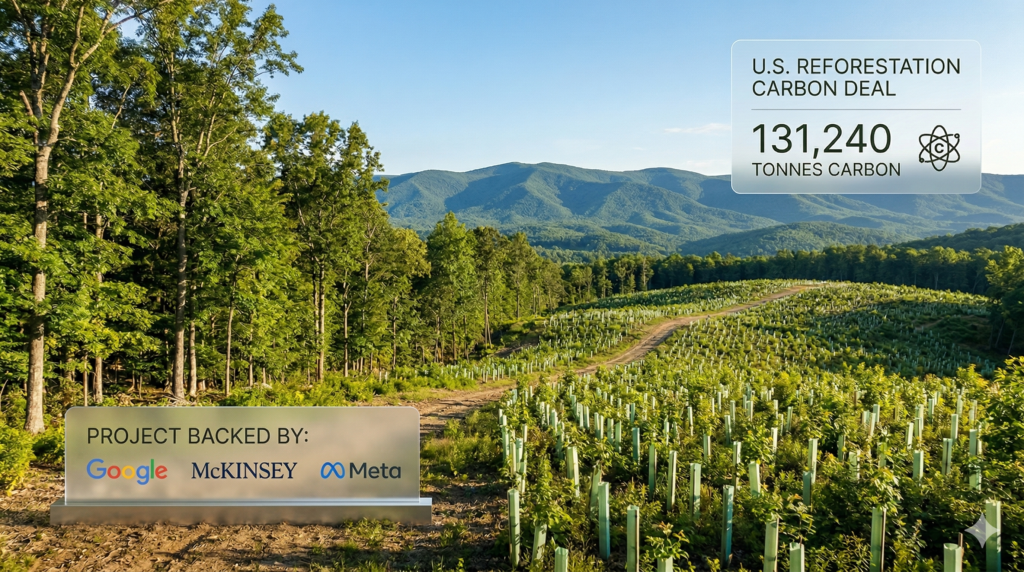
- 131,240 tonnes of carbon removal contracted over 10 years, advancing long-term corporate climate strategies
- Targets restoration of degraded mine and agricultural land across Appalachia, linking carbon markets with land recovery
- Demonstrates growing demand for high-integrity, nature-based carbon credits tied to community and biodiversity outcomes
A group of major corporates is accelerating investment in nature-based carbon removal, backing a reforestation project designed to restore degraded land while delivering measurable emissions reductions.
The Symbiosis Coalition has signed new long-term offtake agreements with Living Carbon, securing 131,240 tonnes of carbon removal over a 10-year period. Coalition members Google, McKinsey, and Meta are among the buyers, committing to support reforestation across former mine sites and underutilized agricultural land in the Appalachian region.
The agreement forms part of Symbiosis’ broader portfolio strategy, aimed at scaling high-quality reforestation and agroforestry projects capable of delivering more than 500,000 tonnes of carbon removal over the next decade. For project developers, multi-year contracts provide the revenue certainty needed to expand operations and attract financing.
Restoring Land Long Left Economically Idle
The project focuses on landscapes that have struggled to recover after decades of industrial use. Across the United States, abandoned mine lands are often marked by poor soil quality, erosion, and contamination, while millions of acres of former agricultural land remain underutilized.
Living Carbon’s approach combines native tree planting with site preparation and invasive species management to enable long-term ecosystem recovery. Hardwood and pine species will be introduced to rebuild natural systems and create durable carbon sinks.
Environmental gains extend beyond carbon removal. The project is expected to improve soil and water quality while restoring habitats for native plant and animal species.
Local economic impact is also central to the model. Landowners receive lease payments for land that would otherwise generate little value, while restoration work creates employment opportunities. Equipment historically used in mining is repurposed for land rehabilitation, tying legacy industries to new forms of economic activity.
Quality Standards Shape Buyer Decisions
“Our support of Living Carbon reflects our belief that effective nature-based carbon removal requires both strong science and solid execution,” said Julia Strong, Executive Director of Symbiosis Coalition. “Their project stands out for its rigor and for its thoughtful and scalable approach shaped around the needs of the local communities, ecosystems, and economies in Appalachia.”
Project selection followed detailed due diligence, including field assessments, geospatial analysis, and third-party technical evaluation. Symbiosis applies five core quality criteria covering accounting integrity, durability, ecological outcomes, community benefit, and transparency.
RELATED ARTICLE: Google, Meta, Microsoft, Salesforce Form Symbiosis Coalition for Nature-Based Carbon Removals
The project will be registered under a reforestation protocol that introduces more robust quantification methods, dynamic baselines, and stricter lifecycle assessment requirements. These frameworks are designed to address long-standing concerns around credit quality and permanence in voluntary carbon markets.
Maddie Hall, CEO and Founder of Living Carbon, said: “We are proud to partner with the Symbiosis Coalition, along with its members, Google, McKinsey, and Meta, to accelerate long-term carbon removal. Multi-year agreements like this provide the confidence needed to invest and scale high-quality, durable removals. This is why Living Carbon exists: we’re intentionally working to turn post-mining and degraded lands in the U.S. from environmental liabilities into productive carbon sinks that not only remove emissions but deliver significant and measurable environmental and social co-benefits as well.”

Carbon Markets Move Toward Scale And Credibility
Nature-based solutions already play a significant role in removing carbon from the atmosphere, but their potential remains underdeveloped. Restoring degraded ecosystems could materially increase global carbon removal capacity over the coming decade.
The challenge has been scaling supply while maintaining quality. Symbiosis’ model seeks to address this by pairing clear standards with long-term purchasing commitments, creating a more stable market environment for developers.
For corporate buyers, the transaction reflects a shift toward fewer, higher-quality credits that deliver verified climate impact alongside biodiversity and social benefits.
For investors and policymakers, the project highlights how carbon finance can be used to support regional economic transformation. In Appalachia, a region historically shaped by extractive industries, reforestation is emerging as a pathway to both environmental recovery and new economic opportunity.
Follow ESG News on LinkedIn

The ESG News Editorial Team is comprised of veteran financial journalists and sustainability analysts dedicated to providing real-time, objective reporting on global ESG regulations, climate finance, and corporate governance. Our desk monitors daily developments from the SEC, IFRS, CSRD and international regulatory bodies to ensure our 1M+ readers receive accurate, data-driven insights into the evolving sustainable investment landscape. Follow the ESG News Editorial Team for expert reporting on global sustainability standards, ESG disclosures, and climate policy. Access over 10,000 investigative reports and real-time updates.