
Lander Urges NYC Pension Funds to Drop BlackRock, Fidelity, and PanAgora Over Weak Climate Stewardship
• New York City’s pension systems have achieved a 37% cut in financed emissions since 2019 but identify three major asset managers that fall short of net-zero expectations.
• BlackRock’s rollback on proactive U.S. proxy engagement affects $42.3 billion in index mandates and is seen as incompatible with the systems’ decarbonization requirements.
• Fidelity and PanAgora face recommended mandate terminations for applying restrictive SEC interpretations that limit climate stewardship and fail to address systemic risk.
New York City Moves to Tighten Climate Expectations for Asset Managers
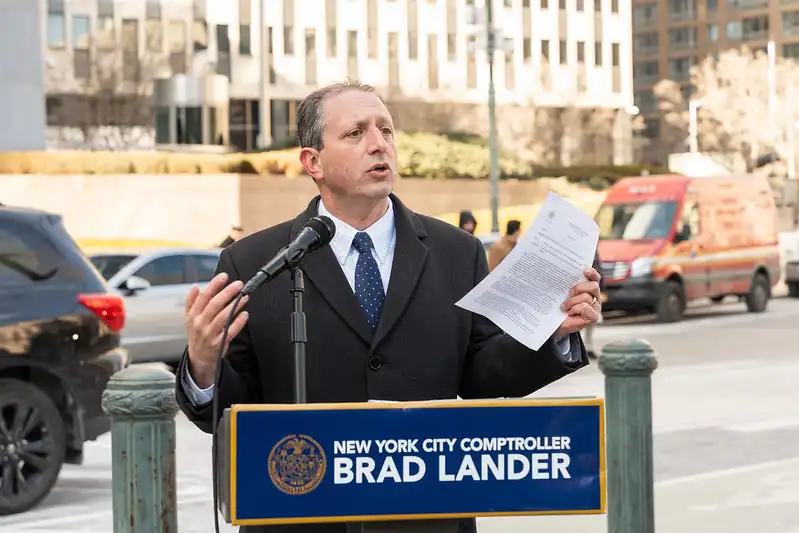
New York City Comptroller Brad Lander has urged the trustees of the city’s three major pension systems to sever ties with BlackRock, Fidelity, and PanAgora after concluding the firms’ climate stewardship plans fall short of the systems’ net-zero requirements.
The recommendation comes in an update to the Net Zero Implementation Plan shared with trustees of the New York City Employees’ Retirement System (NYCERS), the Teachers’ Retirement System (TRS), and the Board of Education Retirement System (BERS). The review assessed all 49 public markets managers responsible for public equity and corporate bond mandates. Forty-six managers submitted decarbonization strategies consistent with the systems’ expectations. Three did not.
“The systemic risk of the climate crisis threatens the long-term value of New York City’s pension funds,” Lander said. “Our Net Zero plan is a core part of our fiduciary duty to protect these assets. I am pleased to report that 46 of our 49 public markets managers are aligned with our expectations for decarbonization; unfortunately, three are not. Today, I am calling on my fellow trustees to move our money away from the three asset managers – BlackRock, Fidelity, and PanAgora – who fail to address climate risk with the seriousness we expect.”
The trustees adopted Net Zero Implementation Plans in 2023, committing the systems to reach net-zero emissions by 2040. Since the 2019 baseline, they have cut financed emissions by 37%, divested fossil-fuel reserve owners, and expanded climate-solution investments to $11.9 billion. Returns have remained strong, reaching 10.5% for FY25, well above the 7% actuarial target.
BlackRock’s Policy Shift Puts Engagement in Question
The most consequential recommendation concerns BlackRock, which manages $42.3 billion in U.S. public equity index mandates for the systems. According to the comptroller’s office, BlackRock’s recent decision to halt proactive engagement on proxy issues with U.S. companies in which it holds 5% or more renders its stewardship insufficient for net-zero alignment.
The firm attributed the shift to Trump-era SEC rule changes. The comptroller’s analysis countered that other large managers—State Street among them—continue to pursue robust climate engagement despite the new guidance. The review cited additional gaps in BlackRock’s climate stewardship: while the firm expanded access to its Climate and Decarbonization Stewardship policy, the submission “does not meet the Systems’ expectations” for encouraging portfolio companies to set net-zero goals, adopt science-based targets, or align lobbying and capital spending with decarbonization pathways.
Lander is urging trustees to rebid the full BlackRock index mandate.
Fidelity and PanAgora Face Recommended Terminations
Fidelity’s approach diverged further. The firm applied SEC guidance not only to U.S. companies but also to its international holdings, limiting its ability to influence portfolio companies on climate issues even when financially material. Lander recommends that TRS terminate Fidelity’s World ex-US small-cap mandate and develop a reallocation plan for its $384 million in assets.
PanAgora, the only quantitative manager to apply such a restrictive interpretation, offered climate engagement limited to emissions disclosure. According to the review, PanAgora does not encourage companies to set targets or adopt transition plans. Lander recommends NYCERS and TRS end PanAgora’s U.S. small-cap equity mandates.
Direct Engagement Remains a Core Strategy
While the pension systems rely on asset managers for stewardship, they also run direct engagement with high-emitting portfolio companies. Lander and the Bureau of Asset Management have engaged more than 100 companies to push for science-based targets and credible transition plans.
Utilities have been a major focus because they account for 20–30% of the systems’ financed emissions. The comptroller’s office participated in the Electric Power Research Institute’s advisory group developing the SMARTargets protocol. After extensive review, the office concluded that SMARTargets “is not yet an acceptable methodology for target setting and presents a significant greenwashing risk.”
To accelerate progress, Lander convened more than 60 asset owners, managers, utilities, and service providers to identify a path toward target-setting tools that meet investor expectations and prevent weak commitments from being misrepresented as credible.
RELATED ARTICLE: NYC Comptroller Lander Proposes Fossil Fuel Ban in Pension Funds
Pushing the Fossil-Fuel Exit Further
The update also reiterates Lander’s proposal that the systems cease future investments in midstream and downstream fossil-fuel infrastructure. This would extend the existing private-markets prohibition on upstream fossil-fuel investments adopted in 2023.
Excluding pipelines, LNG terminals, and related infrastructure is intended to reduce systemic climate risk and prevent the pension systems from financing assets that conflict with the Paris Agreement. According to Lander, doing so protects both global climate goals and the “long-term investment returns needed to fund NYC employees’ pension benefits.”
What Executives and Investors Should Watch
The recommendations deepen a broader shift in public-fund governance: asset managers are now expected not only to disclose climate risk but to demonstrate high-quality engagement strategies aligned with global transition pathways. For large managers, New York City’s evaluation will be closely watched by other U.S. public pension systems, many of which have adopted net-zero targets but vary widely in stewardship expectations.
The trustees of NYCERS, TRS, and BERS will now decide whether to rebid or terminate the identified mandates. Their decision will help define how U.S. fiduciaries interpret climate risk in portfolio management at a moment when federal guidance remains contested and investor engagement faces political headwinds.
Follow ESG News on LinkedIn

The ESG News Editorial Team is comprised of veteran financial journalists and sustainability analysts dedicated to providing real-time, objective reporting on global ESG regulations, climate finance, and corporate governance. Our desk monitors daily developments from the SEC, IFRS, CSRD and international regulatory bodies to ensure our 1M+ readers receive accurate, data-driven insights into the evolving sustainable investment landscape. Follow the ESG News Editorial Team for expert reporting on global sustainability standards, ESG disclosures, and climate policy. Access over 10,000 investigative reports and real-time updates.