Qinghai Links Ecological Restoration With One of China’s Cleanest Power Grids
• Clean energy supplies 90.6% of Qinghai’s electricity, placing the province among China’s lowest carbon power systems
• Large-scale ecological restoration has cut desertified land in key areas from 90% to 12.3% while protecting the headwaters of Asia’s major rivers
• Solar thermal capacity under operation and construction has reached 2.06 million kilowatts, the highest total in China
On the high-altitude plateaus of northwest China, Qinghai Province is testing whether large scale clean energy deployment can coexist with aggressive ecological restoration in some of the country’s most fragile landscapes.
Qinghai sits at the source of the Yangtze, Yellow, and Lancang (Mekong) rivers, waterways that underpin water security, agriculture, and economic activity far beyond China’s borders. Long viewed primarily through the lens of conservation, the province is now also emerging as a strategic pillar of China’s clean energy system, pairing ecosystem protection with rapid renewable power expansion.
Restoring fragile ecosystems at scale
The province’s ecological importance is difficult to overstate. Sanjiangyuan National Park, the largest national park in China, anchors Qinghai’s conservation efforts and provides critical habitat for species including the snow leopard, Tibetan antelope, and black-necked crane. The area is frequently described as a paradise for wildlife and a “genetic treasury of nature,” a phrase that reflects both its biodiversity and its role in safeguarding upstream ecosystems for hundreds of millions of people downstream.
In recent years, provincial authorities have intensified efforts to reverse decades of desertification, particularly in grassland and semi-arid zones. Shazhuyu Township offers one of the clearest examples. Once among the most severely desertified areas in the country, the township has been transformed through measures such as straw-grid sand control and land rehabilitation. According to local data, green land coverage has expanded dramatically, cutting desertified land from roughly 90% to 12.3%.
For policymakers, these outcomes serve a dual purpose. They stabilize fragile soils and ecosystems while creating the conditions needed for long-term economic activity, including renewable energy infrastructure, without accelerating environmental degradation.
Building a clean energy stronghold
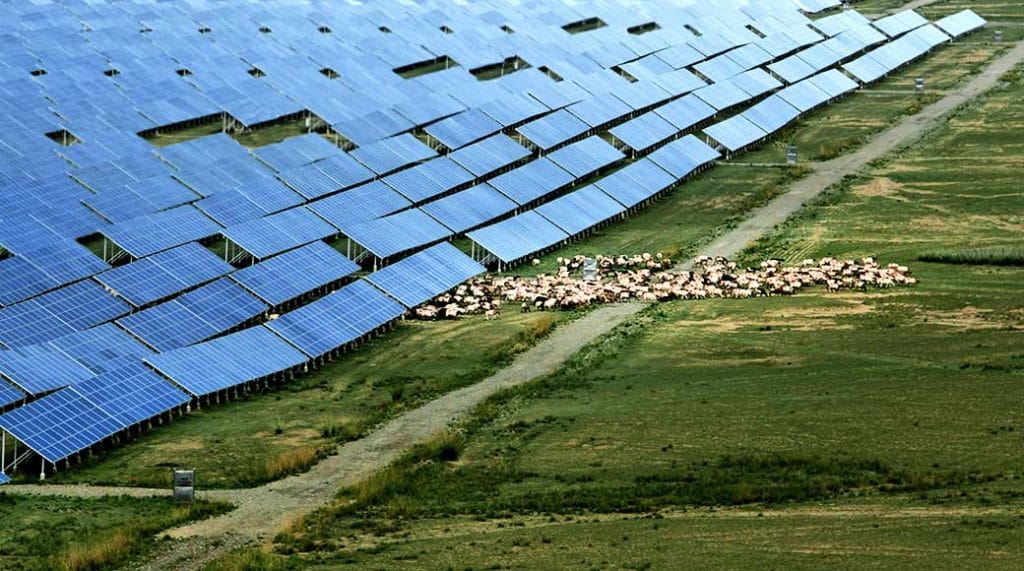
Alongside restoration, Qinghai has moved quickly to industrial-scale clean power generation. Vast arrays of solar panels and wind turbines now stretch across its deserts and grasslands, taking advantage of intense plateau sunlight and strong, consistent winds.
Solar thermal power has become a particular focus. The combined capacity of operational and under-construction solar thermal projects has reached 2.06 million kilowatts, the highest level nationwide. This positions Qinghai not only as a renewable generation base but also as a testing ground for dispatchable solar technologies that can support grid stability.
RELATED ARTICLE: Fervo Secures $462 Million to Scale Geothermal and Deliver 24/7 Clean Power
The province has also established China’s first green power corridor, enabling clean electricity generated in Qinghai to be transmitted to other regions. As of October 2025, clean energy sources accounted for 90.6% of the province’s electricity generation, according to official local data. That figure places Qinghai well ahead of national averages and strengthens Beijing’s broader decarbonization objectives.
Governance and system implications
For central authorities, Qinghai’s approach aligns with national priorities that increasingly emphasize coordinated environmental protection and energy security. The province’s model reflects a governance shift away from treating conservation and industrial development as competing goals, toward integrating both within a single planning framework.
From a financial perspective, the scale of renewable deployment and grid infrastructure signals sustained capital requirements. Large transmission projects, solar thermal facilities, and land restoration programs demand long-term investment horizons, predictable policy support, and clear environmental safeguards. For investors and state-backed lenders alike, Qinghai illustrates how ecological constraints are shaping the geography and structure of China’s clean energy build-out.
Why this matters beyond Qinghai
Qinghai’s experiment carries significance far beyond provincial borders. As climate risks intensify and water security becomes a geopolitical concern across Asia, protecting the headwaters of major rivers while decarbonizing power systems addresses two systemic risks at once.
Going forward, provincial officials say Qinghai aims to deepen the integration of ecological conservation and clean energy development, positioning the region as a national reference point for sustainable growth in environmentally sensitive areas. For global climate and ESG leaders, the province offers a live case study in how policy, capital, and environmental stewardship can be aligned under challenging natural conditions, with implications for other high-altitude, biodiversity-rich regions pursuing net-zero transitions.
Follow ESG News on LinkedIn

The ESG News Editorial Team is comprised of veteran financial journalists and sustainability analysts dedicated to providing real-time, objective reporting on global ESG regulations, climate finance, and corporate governance. Our desk monitors daily developments from the SEC, IFRS, CSRD and international regulatory bodies to ensure our 1M+ readers receive accurate, data-driven insights into the evolving sustainable investment landscape. Follow the ESG News Editorial Team for expert reporting on global sustainability standards, ESG disclosures, and climate policy. Access over 10,000 investigative reports and real-time updates.