Verra Issues First CCP Labeled Forest Carbon Credits Under Updated IFM Methodology
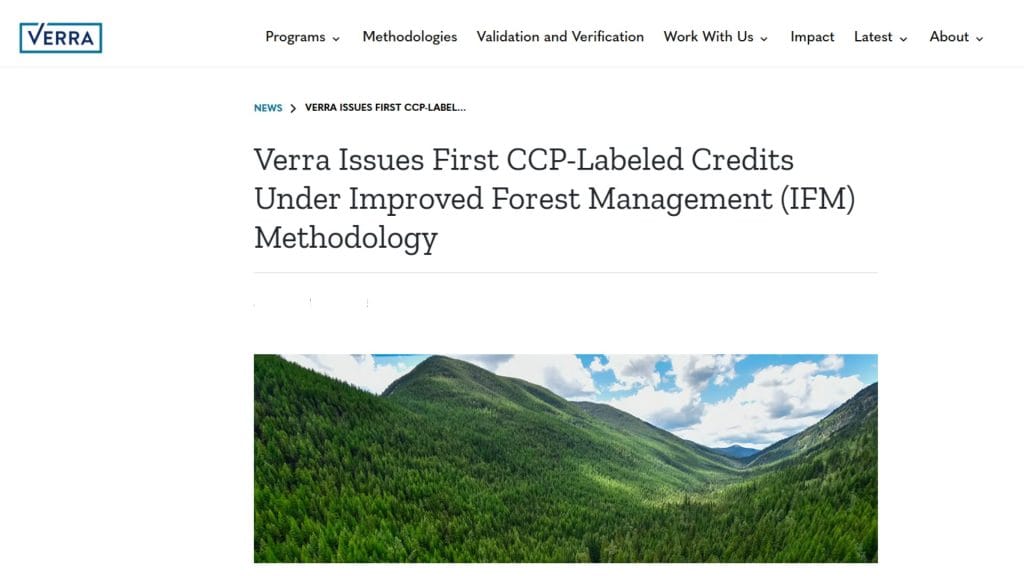
• Verra issues 18,326 CCP labeled credits under the newly approved VM0045 Improved Forest Management methodology using dynamic, data driven baselines.
• The American Forest Foundation’s Central Appalachia project becomes the first to transition to the ICVCM approved version 1.2 standard.
• The methodology opens a path for small acreage landowners into high integrity carbon markets and provides a framework for global replication.
Verra has issued the first carbon credits carrying the Integrity Council for the Voluntary Carbon Market’s Core Carbon Principles label under its revised Improved Forest Management methodology, VM0045, marking a significant development in the governance of forest carbon accounting and the economics of land stewardship.
The credits were issued to the Family Forest Carbon Program in Central Appalachia, a project developed by the American Forest Foundation with support from The Nature Conservancy. The project received 18,326 Verified Carbon Units after proactively shifting from version 1.1 to version 1.2 of VM0045 once the Integrity Council granted approval. This decision positioned the program as an early adopter of one of the most scrutinised methodologies in the forest sector and reinforced the project’s commitment to environmental integrity and transparent carbon finance.
A Methodology Built on Real World Data
VM0045 Improved Forest Management Using Dynamic Matched Baselines from National Forest Inventories introduces a data intensive approach to forest carbon measurement. Instead of static assumptions and long term projections, the methodology uses continuously updated forest inventory datasets to establish dynamic baselines that reflect actual forest conditions.
Verra is implementing the approach using data from the United States Forest Service’s Forest Inventory and Analysis database, one of the most extensive national forest datasets globally. The methodology is designed to be replicable in any country with a sufficiently robust national forest inventory, and the registry is already preparing the groundwork to enable comparable use of country level datasets elsewhere.
A Shift in Access for Small Landowners
One of the method’s most consequential features is the way it lowers structural barriers for small acreage landowners who have traditionally been unable to participate in voluntary carbon markets. High transaction costs, complex modeling requirements and limited access to technical expertise have kept millions of hectares of family owned forests outside carbon finance mechanisms. The dynamic baseline framework offers a more predictable, lower cost path into crediting, which is expected to draw interest from rural communities and private forest owners who have been effectively excluded from market participation.
Verra CEO Mandy Rambharos highlighted that shift, stating, “This is a powerful example of how innovation and integrity can work hand in hand to unlock new opportunities for forest stewardship. VM0045 not only meets the highest standards of climate rigor but also empowers rural landowners to participate in climate action in innovative and impactful ways. We’re proud to see CCP labeled credits being generated by a project that puts family forest owners at the center of the solution.”

RELATED ARTICLE: Verra Launches Digital Soil Mapping Tool to Boost Agricultural Carbon Projects
Governance and Market Implications
The Integrity Council’s approval of the methodology is a critical signal for investors and corporate buyers seeking higher quality, less volatile carbon assets. With growing scrutiny over forest credit durability and baseline inflation, the dynamic matched baseline model answers several of the concerns that have slowed investment into nature based offsets.
For carbon market developers, the issuance demonstrates that shifting to ICVCM aligned methodologies is not only viable but commercially relevant. It provides early evidence that the market will reward projects that adopt more transparent and data driven approaches, even when this requires redesigning existing protocols.
For regulators and policymakers, the development strengthens the case for national forest inventory investments. Countries with credible, up to date forest datasets will be better positioned to host ICVCM aligned forest projects and benefit from cross border carbon finance flows.
A Framework with Global Reach
Although the first issuance is based on U.S. forest data, VM0045 is explicitly designed for international application. Many countries in Latin America, Africa and Southeast Asia maintain national forest inventories, though with varying degrees of completeness. Verra confirmed that additional work is underway to expand the methodology’s compatibility with national datasets beyond the United States, opening potential pathways for high integrity crediting in regions where forest conservation is directly tied to development objectives.
Why This Matters for C Suite, Investors and Sustainability Leaders
The issuance provides an early view of what high integrity nature based credits may look like under the next regulatory cycle. It aligns with tightening buyer expectations, emerging compliance market links and investor pressure for quantifiable climate outcomes. It also clarifies that forest carbon methodologies can evolve toward more rigorous, evidence based models without shutting down market participation for smaller landowners.
As voluntary carbon markets move toward global standardisation, the VM0045 issuance positions dynamic baseline accounting as a credible template for future methodologies. It also reinforces the view that transparent governance structures, independent validation and verifiable datasets will determine market confidence in nature based climate solutions.
With more jurisdictions preparing to integrate voluntary credits into national climate planning, the development carries weight far beyond the United States. Countries seeking to attract climate finance or stabilise forest carbon programs will be watching closely as additional VM0045 based projects move through validation and issuance.
Follow ESG News on LinkedIn

The ESG News Editorial Team is comprised of veteran financial journalists and sustainability analysts dedicated to providing real-time, objective reporting on global ESG regulations, climate finance, and corporate governance. Our desk monitors daily developments from the SEC, IFRS, CSRD and international regulatory bodies to ensure our 1M+ readers receive accurate, data-driven insights into the evolving sustainable investment landscape. Follow the ESG News Editorial Team for expert reporting on global sustainability standards, ESG disclosures, and climate policy. Access over 10,000 investigative reports and real-time updates.