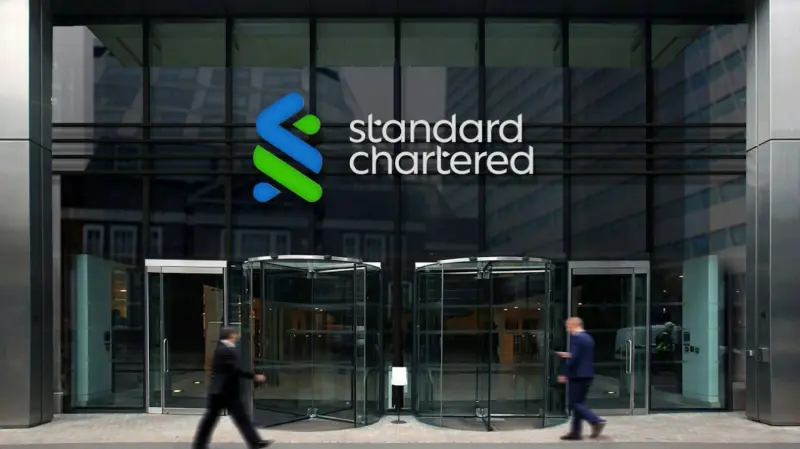
Standard Chartered Sets 2050 Net Zero Financing Target and $300 Billion Sustainable Finance Goal
- Targets net zero financed emissions by 2050 and operational emissions by 2025, with 2030 interim targets across all 12 NZBA high-emitting sectors
- Mobilised $121 billion in sustainable finance since 2021, aiming for $300 billion by 2030 and over $1 billion in annual sustainable finance income by 2025
- First Global Systemically Important Bank to secure external confirmation of sectoral targets aligned with the Paris Agreement
Standard Chartered has released a comprehensive Transition Plan that places climate considerations at the centre of its financing, governance and client engagement strategy, sharpening its pathway to net zero while reinforcing its growth ambitions across Asia, Africa and the Middle East.
The plan sets out how the bank intends to achieve net zero across its financing activity by 2050, covering Scope 3 financed emissions, and across its own operations by 2025, covering Scope 1 and Scope 2. The primary focus is on financed emissions tied to high-emitting sectors, where the scale of decarbonisation required presents both material risk and commercial opportunity.
Bill Winters, Group Chief Executive at Standard Chartered, said: “As a global bank serving the cross-border needs of our clients, we’re clear that the transition to a low carbon economy presents a significant opportunity to accelerate sustainable and enduring growth across our markets. Whether we’re supporting clients with their transition strategies and business models of the future, developing solutions to finance new innovative technologies, or financing low-carbon infrastructure projects in India, Indonesia, South Africa, and beyond – it is important business for Standard Chartered. It makes commercial sense, and the numbers speak for themselves. As set out in our Annual Report 2024 last week, we are on track to generate over USD1 billion in Sustainable Finance income by the end of this year.”

Science-Based Targets and External Validation
The Transition Plan builds on the bank’s Net Zero Roadmap published in 2021 and aligns with frameworks from the Transition Plan Taskforce and the Glasgow Financial Alliance for Net Zero. Standard Chartered has now completed interim 2030 target setting across all twelve high-emitting sectors identified by the Net-Zero Banking Alliance.
Dana Barsky, Global Head, Sustainability Strategy and Net Zero at Standard Chartered, said: “In order to assure integrity in our process and have a sound reference point underpinning our targets and progress, the Bank has consciously chosen a science-based approach to its net zero programme. We also engaged EY to confirm that our targets for Aluminium, Automotive Manufacturers, Cement, Commercial Real Estate, Oil and Gas, Power, Shipping, Steel and Coal, meet the long-term temperature goal of the Paris Agreement, and are mathematically accurate in reference to third-party scientific scenarios. We’re pleased to say that Standard Chartered is the first Global Systemically Important Bank (GSIB) to have such external confirmation of its targets.”
Among the sector-specific commitments is an absolute facilitated emissions target for oil and gas, requiring a 29 percent reduction in financed emissions by 2030 from a 2020 baseline. The move introduces a carbon budget approach to one of the most scrutinised portfolios in global banking.
RELATED ARTICLE: Standard Chartered Secures $235M Green Loan for Texas Solar Plant
Governance, Controls and Client Engagement
The Transition Plan details the governance architecture supporting delivery, including oversight of net zero calculations, target management and decision-making processes. It also addresses engagement strategies for both New-to-Bank and Existing-to-Bank clients, emphasising structured transition conversations and the deployment of sustainable and transition finance products.
Marisa Drew, Chief Sustainability Officer at Standard Chartered, said: “The transition to a low carbon economy is both more compelling and crucial than ever. As a bank that offers access to sustainable growth opportunities across Asia, Africa and the Middle East, we believe Standard Chartered has an important role to play in supporting our clients and markets as they navigate complicated transition challenges, while keeping the overriding objective of the sustainable transition of the real-world economy firmly in our sight lines. This Transition Plan represents an important milestone as we continue to deliver against our Net Zero Roadmap, which we published in 2021, and remains unchanged. It speaks to the collaborative efforts of teams across the bank and will serve as a fundamental catalyst for delivery, translating our commitments into a framework for operationalising and executing on our net zero agenda.”

Financial Performance and Strategic Positioning
The bank’s 2024 results reinforce the commercial dimension of its climate strategy. Standard Chartered generated $982 million in sustainable finance income in 2024 and remains on course to exceed $1 billion annually by 2025. Since January 2021, it has mobilised $121 billion in sustainable finance, with a stated goal of $300 billion by 2030.
It has also become an early adopter of the Taskforce on Nature-related Financial Disclosures, broadening its risk lens beyond carbon.
For C-suite leaders and investors, the message is direct. Climate alignment is no longer a parallel reporting exercise but an operational and revenue driver embedded in core banking strategy. With science-based targets validated externally and governance controls codified, Standard Chartered is positioning its transition plan as both a risk management tool and a growth platform.
As regulatory scrutiny intensifies and capital allocation increasingly reflects climate credibility, the bank’s approach highlights a broader shift within global finance. The transition agenda is moving from pledges to portfolio management, from aspiration to execution, particularly in emerging markets where growth and decarbonisation must advance together.
Follow ESG News on LinkedIn

The ESG News Editorial Team is comprised of veteran financial journalists and sustainability analysts dedicated to providing real-time, objective reporting on global ESG regulations, climate finance, and corporate governance. Our desk monitors daily developments from the SEC, IFRS, CSRD and international regulatory bodies to ensure our 1M+ readers receive accurate, data-driven insights into the evolving sustainable investment landscape. Follow the ESG News Editorial Team for expert reporting on global sustainability standards, ESG disclosures, and climate policy. Access over 10,000 investigative reports and real-time updates.