Tim Mohin: EU Sustainability at the Crossroads
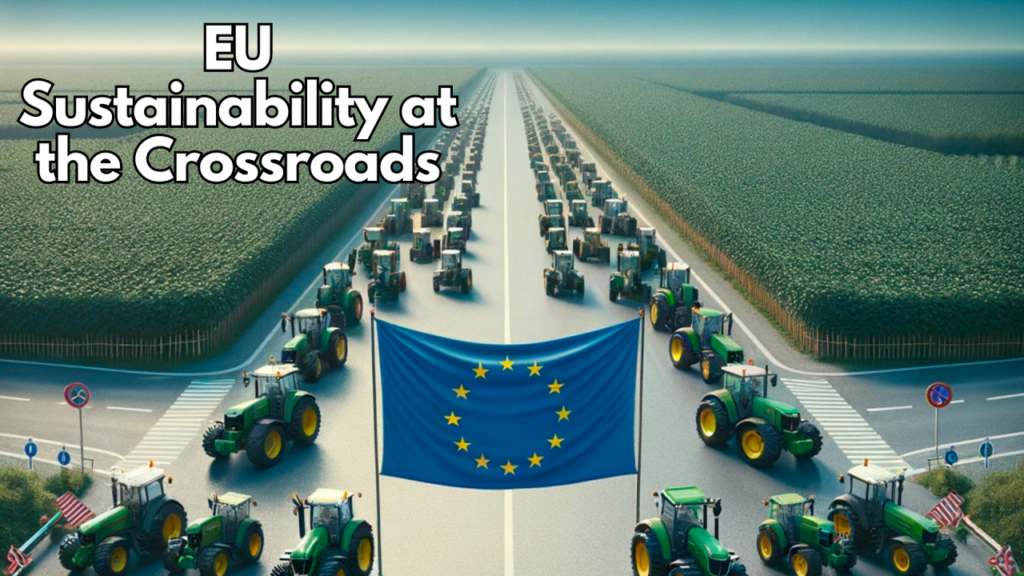
This week, tractors blocked highways across France, conducting “the siege of Paris,” partly in protest of unfair environmental standards driven by the EU Green Deal. Similar protests were seen across the continent as European mettle to stay the course in the Green Deal is being tested.
Paradoxically, also this week, the EU parliament finalized the text for the far-reaching Corporate Sustainability Due Diligence Directive, which will require thousands of EU and non-EU companies to identify, prevent, and mitigate any negative human rights and environmental impacts in their operations and value chains.
The rules, which will be phased in beginning in 2026 for EU companies and 2029 for non-EU ones, will not include financial institutions for now. The EU parliament and Council will ratify this final text between February 9th and 13th.
The dichotomy of politicians pressing on with an ultra-progressive sustainability agenda while discontent grows among stakeholders and voters portends uncertainty as the new policies start to bite.
RELATED ARTICLE: Tim Mohin: Climate on the Ballot in Largest Election Year
It is not just from farmers. Businesses are pushing back on the EU’s agenda as well. One large US multinational’s anecdote of the cost of complying with the Corporate Sustainability Reporting Directive revealed that they expect to spend $50-60 million for compliance over the next 3-5 years, with an additional recurring $6 million for auditing and any additional sector-specific guidance.
Concern over compliance costs has driven businesses to question whether the Green Deal weakens EU companies’ competitiveness. A claim EU’s climate chief Wopke Hoekstra, calls a “false narrative,” claiming that Europe will continue to have a “world-class, second to none, business environment.” He was speaking ahead of an expected February 6th announcement of a new EU goal of reducing emissions 90% by 2040, which could further enrage farmers and businesses.
The main impact of the backlash so far has been a shift in spending from green innovations to defense spending. A common innovation fund was changed to ensure it could only invest in arms, and the European Investment Fund is under pressure to fund more defense projects.
It is feared these farmer protests, which have already seen the EU back down on one of their agricultural biodiversity policies, could embolden right-wing politicians ahead of the June EU elections.
This Smart Read article is contributed by Tim Mohin, Global Sustainability Leader, BCG. Every week ESG News delivers smart commentary from ESG practitioners and experts to unpack issues of the week. Submit your ESG Smart Read to editor@esgnews.com

Tim Mohin is weekly smart read contributor to ESG News. Tim is globally recognized sustainable business executive. He is a partner and director for the Boston Consulting Group (BCG) in climate and sustainability.
Prior to BCG, Tim was the EVP and Chief Sustainability Officer with leading carbon accounting software company – Persefoni . He is the former Chief Executive of the Global Reporting Initiative (GRI), the world’s largest sustainability reporting standard.
He brings more than 20 years’ experience leading sustainability functions at three Fortune 500 companies – Intel, Apple and AMD – Tim has deep experience developing strategies to embed sustainability into business. Tim also led the development of environmental policy in the Environmental Protection Agency and the United States Senate, including the Clean Air Act. He is a sustainability advisor to the Financial Conduct Authority of the United Kingdom, the Board of BASF, Workiva and others. Previously, Tim was a founder and Chairman of the Board for the Responsible Business Alliance.
He is the author of Changing Business from the Inside Out and a frequent speaker and writer on sustainability and corporate responsibility. Tim writes a weekly ESG Newsletter, and is one of LinkedIn’s 2022 Top Voices in the Green Economy. He is consistently recognized in the top 20 of Corporate Social Responsibility Influence Leaders.