Vietnam Certifies 71,000 Tonnes of Low Emission Rice Under National Green Farming Programme
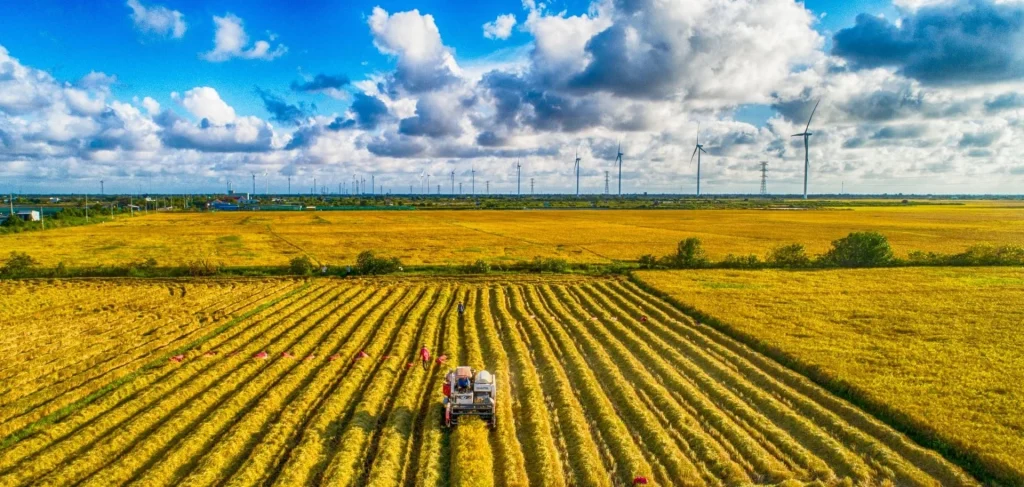
- 71,000 tonnes of rice certified under Vietnam’s Low Emission Green Rice label across 18,000 hectares in the Mekong Delta
- Eight exporters now shipping certified rice globally, positioning Vietnam as the first country to export low emission rice at scale
- Programme ties agricultural emissions reduction to traceability, farmer behaviour change, and cooperative reform
In the heart of the Mekong Delta, Vietnam’s rice sector is quietly reshaping how agricultural emissions, farmer livelihoods, and export competitiveness intersect. Over the past two years, up to 71,000 tonnes of rice have been certified under the Low Emission Green Vietnamese Rice label, according to the Vietnam Rice Sector Association, known as VIETRISA.
The certification sits at the centre of the government backed One Million Hectare Programme, a national initiative aiming to develop one million hectares of high quality, low emission rice linked to green growth by 2030. The programme reflects Vietnam’s effort to align its agricultural exports with global climate expectations while preserving its position as one of the world’s leading rice suppliers.
A certification model built on traceability and emissions discipline
The Low Emission Green Vietnamese Rice label is granted by VIETRISA to rice that complies with technical standards established under the One Million Hectare Programme. Verification is conducted by commune level authorities or accredited international organisations.
Certified rice must meet strict traceability requirements covering production areas, rice varieties, and cropping seasons. It must also comply fully with low emission, high quality cultivation protocols, including water management, fertiliser reduction, and residue handling.
VIETRISA has issued label use certificates to eight enterprises cultivating a combined area of roughly 18,000 hectares, said Vice Chairman Le Thanh Tung at a meeting in Can Tho city.
“The eight companies are currently exporting about 70,000 tonnes of low emission rice under the One Million Hectare Programme, out of roughly 400 rice exporters nationwide,” Tung said.
First mover advantage in low emission rice exports
According to Tung, Vietnam has become the world’s first country to produce and export low emission rice under a nationally certified framework. While participation remains limited in absolute numbers, the exports signal an early shift in how emissions performance is being embedded into agricultural trade.
“While the number of participating companies remains limited, the exports reflect the project’s early progress and the challenges of its initial implementation,” Tung said.
For investors and global buyers, the certification provides a credible signal that emissions claims are linked to traceable production practices rather than offset mechanisms or marketing narratives.
Behaviour change as the hidden constraint
Vice Chairman of the National Assembly Le Minh Hoan framed the programme’s biggest challenge not as technology or agronomy, but as human behaviour.
“Discussions on the programme frequently focus on rice varieties, cultivation techniques, irrigation, fertiliser reduction, and emissions targets,” Hoan said. “But behavioural change cannot be measured by machines or found in rice fields.”
Hoan argued that farmers respond more readily to practical examples than to abstract climate metrics. He placed particular emphasis on the role of the media in translating policy into lived experience.
“If policy is a blueprint, then the press is the storyteller of life within that blueprint,” he said.
Rather than emphasising emissions statistics, Hoan said coverage should highlight farmers who sow less densely and achieve healthier crops, reduce post harvest burning, or lower input costs while maintaining yields. These stories, he said, make change appear practical and attainable.
RELATED ARTICLE: Vietnam EV Maker VinFast Secures $2.5 Billion in Funding
Cooperatives and credibility in the transition
Hoan also described agricultural cooperatives as a core pillar of the programme, noting that reform cannot rely solely on administrative directives.
He said the media could contribute by showcasing successful cooperatives, explaining management changes, and identifying gradual but sustainable improvements. Coverage should neither exaggerate achievements nor focus solely on shortcomings, but instead outline clear pathways for replication.
“The press should act as a practical guide to innovation rather than portraying it as an abstract goal,” Hoan said.
For businesses participating in the programme, Hoan said financial incentives alone are insufficient. Companies must also build credibility, trust, and a socially responsible image.
He added that the media can support this process by recognising enterprises that make long term investments alongside farmers and by telling brand stories grounded in sustainable farming practices.
As Vietnam moves toward its 2030 target, the Low Emission Green Rice label offers a test case for how agricultural policy, climate goals, and export markets can converge. For global food supply chains under pressure to decarbonize, the Mekong Delta is emerging as an early reference point.
Follow ESG News on LinkedIn

The ESG News Editorial Team is comprised of veteran financial journalists and sustainability analysts dedicated to providing real-time, objective reporting on global ESG regulations, climate finance, and corporate governance. Our desk monitors daily developments from the SEC, IFRS, CSRD and international regulatory bodies to ensure our 1M+ readers receive accurate, data-driven insights into the evolving sustainable investment landscape. Follow the ESG News Editorial Team for expert reporting on global sustainability standards, ESG disclosures, and climate policy. Access over 10,000 investigative reports and real-time updates.