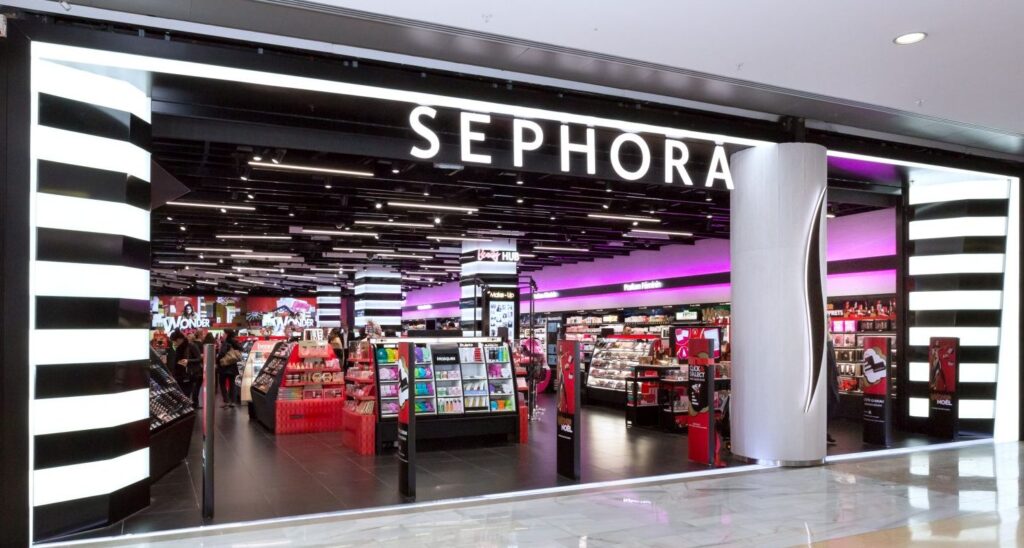
Sephora, Saie Launch Earth Month Retail Campaign To Remove 1 Million Pounds Of Plastic Waste
- Campaign links retail purchases to plastic recovery, targeting 1 million pounds of waste removed across emerging markets
- Beauty industry produces 120 billion packaging units annually, with only 9% recycled, placing pressure on brands and regulators
- Model channels funding into circular economy infrastructure and community jobs in India, Indonesia, Kenya and Colombia
Clean beauty brand Saie has partnered with Sephora to launch a month-long Earth Month campaign that ties consumer purchases directly to plastic recovery across emerging markets, offering a retail-driven model for tackling one of the beauty industry’s most persistent ESG challenges.
Running from April 3 to May 1, the “Planet Beautiful” initiative combines in-store activations across the United States with brand contributions and customer participation. The program is executed in partnership with rePurpose Global, which will deploy funds into waste recovery projects in India, Indonesia, Kenya and Colombia.
The structure is simple but scalable. Each participating product purchase triggers a $1 contribution to plastic recovery efforts, with every dollar funding the removal of approximately 2.5 pounds of waste. The campaign is targeting a total of 1 million pounds of plastic removed, equivalent to roughly 34 million mascara tubes.
A Packaging Crisis Driving Industry Scrutiny
The initiative arrives as the global beauty sector faces mounting scrutiny over packaging waste. The industry produces an estimated 120 billion units of packaging annually, the majority of which is plastic. Recycling rates remain low at around 9%, while packaging accounts for roughly 70% of the sector’s total waste footprint.
For regulators and investors, this imbalance has become a focal point. Extended producer responsibility policies, circular economy mandates and ESG disclosure requirements are placing increasing pressure on consumer brands to demonstrate measurable impact across product lifecycles.
Saie’s founder, Laney Crowell, frames the initiative as part of a broader operational philosophy rather than a one-off campaign. “Sustainability has always been foundational to Saie and has been central to how we built the brand from the very beginning,” she said. “When I set out to create Saie, it was always with the intention that products should not only feel good, but do good for people and for the Earth. That means thinking about how sustainability impacts every touchpoint, from our formulas to our packaging to how our community engages with us, including how we show up in-store at Sephora.”

Collaboration As A Lever For Scale
Unlike traditional brand-led sustainability campaigns, “Planet Beautiful” is structured as a multi-stakeholder initiative. A dozen beauty brands, including Biossance, Caudalie, Crown Affair and ILIA, are participating, turning a single-brand effort into a collective retail platform.
This collaborative model reflects a shift in how ESG progress is being operationalized within consumer sectors. Rather than isolated brand commitments, retailers are increasingly positioned as ecosystem enablers, shaping purchasing behavior and post-consumption outcomes at scale.
RELATED ARTICLE: Unilever Makes Inaugural Investment in Sustainable Fragrances – The 7 Virtues
Crowell emphasized the strategic role of retail alignment in achieving meaningful impact. “We are fortunate to work with Sephora, a partner that already prioritizes sustainability and gives us a strong foundation of alignment and connectedness. When brands and retailers collaborate in that way, it allows us to create impact that is not only meaningful, but also scalable.”
The initiative also reinforces the growing importance of retailer influence in circularity outcomes. As the primary interface with consumers, retailers shape how products are discovered, used and ultimately disposed of.
“Retailer collaboration is essential when it comes to driving real progress in recycling and circularity as they shape how products are experienced, discovered and ultimately disposed of.”
Financing Circularity And Community Impact
Beyond environmental metrics, the campaign directs capital into local waste management systems and community development programs. Funds generated through the initiative will support job creation, particularly for women in the waste recovery sector, while strengthening circular infrastructure in high-need regions.
For ESG-focused investors, this dual impact model aligns environmental outcomes with social value creation, an increasingly important consideration in capital allocation strategies.
What Executives And Investors Should Watch
The “Planet Beautiful” campaign highlights a replicable model for embedding sustainability into everyday commercial activity. By linking revenue directly to measurable environmental outcomes, the initiative provides a transparent mechanism for tracking impact.
For C-suite leaders, the takeaway is clear. Retail partnerships can accelerate sustainability outcomes faster than standalone brand efforts, particularly when tied to consumer engagement and clear financial flows.
For policymakers, the campaign offers a market-driven complement to regulation, demonstrating how voluntary initiatives can mobilize capital toward circular economy goals.
As pressure mounts on the beauty sector to address its packaging footprint, initiatives like this point to a future where sustainability is not a separate function but embedded directly into the transaction itself.

The ESG News Editorial Team is comprised of veteran financial journalists and sustainability analysts dedicated to providing real-time, objective reporting on global ESG regulations, climate finance, and corporate governance. Our desk monitors daily developments from the SEC, IFRS, CSRD and international regulatory bodies to ensure our 1M+ readers receive accurate, data-driven insights into the evolving sustainable investment landscape. Follow the ESG News Editorial Team for expert reporting on global sustainability standards, ESG disclosures, and climate policy. Access over 10,000 investigative reports and real-time updates.