

China Clean Tech Exports Avoid 374 Million Tons of CO2
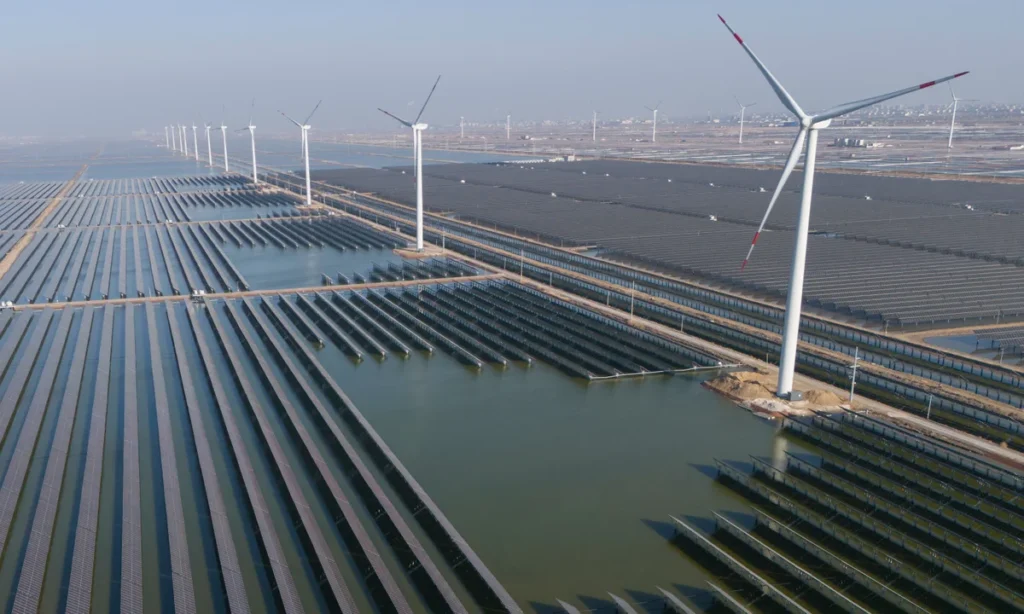
- 374 million tons: Chinese clean technology exports avoided an estimated 374 MtCO2 in 2025, exceeding the UK’s annual emissions.
- 6.9 billion tons: Over their lifetimes, China’s 2025 clean tech exports are expected to avoid 6,900 MtCO2, up 31% from 2024.
- $194 billion: China exported $194 billion of solar panels, batteries, wind turbines and electric vehicles last year, with emerging markets driving adoption.
China’s expanding clean technology export machine is having a measurable impact on emissions far beyond its borders. New analysis estimates that Chinese exports avoided 374 million metric tons of carbon dioxide in 2025.
That is more CO2 than the UK emitted over the same period.
The analysis comes from Lauri Myllyvirta, co-founder of the Helsinki-based Centre for Research on Energy and Clean Air. It covers exports of solar panels, batteries, wind turbines and electric vehicles.
The longer-term climate impact is considerably larger. Over their operating lifetimes, clean technologies exported from China in 2025 are expected to avoid 6,900 MtCO2. That is 31% higher than the equivalent estimate for 2024 and roughly twice India’s annual emissions.
China’s manufacturing scale reshapes clean energy economics
China occupies a complex position in the global energy transition. It remains the world’s largest carbon emitter while also producing much of the technology used to cut emissions elsewhere.
Its vast manufacturing base has pushed down the cost of solar panels, batteries, electric vehicles and wind turbines. That has changed the economics of electrification, particularly in emerging and developing economies.
“Current growth of solar and EVs, particularly in emerging countries, was not on anyone’s radar five years ago before China’s cleantech manufacturing boom,” said Myllyvirta.
“Just as the manufacturing boom led to increased supply and falling prices, the world experienced two fossil fuel price shocks in the past five years, giving adoption a further push. “

The combination of cheaper technology and volatile fossil fuel prices has strengthened the economic case for clean energy. It has also widened access to technologies that were previously more difficult for lower-income markets to deploy at scale.
RELATED ARTICLE: China Allocates $319M for Farm Disaster Prevention
South Asia emerges as a major beneficiary
Solar is responsible for a significant share of the emissions impact.
Almost one-third of the avoided emissions identified in the analysis came from Chinese solar exports to South Asia. Pakistan has emerged as a particularly striking example.
The country is experiencing a rapid solar expansion that has pushed its share of solar electricity generation among the highest globally. Low-cost Chinese panels have helped households and businesses adopt distributed solar as they respond to energy costs and grid constraints.
The trend shows how China’s manufacturing policies increasingly influence emissions trajectories outside its own borders.
For governments, the shift also creates a policy balancing act. Access to inexpensive Chinese technology can accelerate national climate and energy targets. At the same time, growing dependence on one manufacturing hub raises questions about supply-chain concentration, trade policy and domestic industrial competitiveness.
Clean tech exports become a $194 billion industry
The climate impact sits alongside a substantial commercial opportunity.
Chinese exports of solar panels, wind turbines, batteries and electric vehicles were worth $194 billion last year, according to Chinese customs data. Shipments had already reached $128 billion by June this year.
Those flows increasingly connect China’s industrial strategy with the investment plans of governments, utilities and companies across emerging markets.
For investors and corporate leaders, falling technology costs can improve the economics of renewable power procurement, electrification and clean infrastructure. Yet geopolitical tensions and trade restrictions remain important risks when assessing long-term supply chains.
Global emissions remain the larger test
The avoided emissions are substantial, but they remain modest against the scale of the global climate challenge.
Global carbon emissions reached about 39 billion tons in 2024, according to data compiled by Our World in Data. China’s exported technologies therefore address only a fraction of annual worldwide emissions.
Their importance lies in the direction and scale of deployment. China is no longer influencing the energy transition only through its domestic emissions or climate policies. Its manufacturing capacity is increasingly shaping how quickly other economies can access and deploy low-carbon technology.
As governments pursue renewable energy and electrification targets, the global impact of China’s clean tech sector will increasingly depend on where its products go, how quickly they are deployed and whether lower costs continue to accelerate adoption across emerging markets.

The ESG News Editorial Team is comprised of veteran financial journalists and sustainability analysts dedicated to providing real-time, objective reporting on global ESG regulations, climate finance, and corporate governance. Our desk monitors daily developments from the SEC, IFRS, CSRD and international regulatory bodies to ensure our 1M+ readers receive accurate, data-driven insights into the evolving sustainable investment landscape. Follow the ESG News Editorial Team for expert reporting on global sustainability standards, ESG disclosures, and climate policy. Access over 10,000 investigative reports and real-time updates.


