
Behind the Crown: How Rolex Turned Quiet Values Into Its Strongest Statement
In a milestone year, a record-breaking museum gift, 50 years of the Rolex Awards and a new podcast season reveal a commitment that speaks through the people it supports
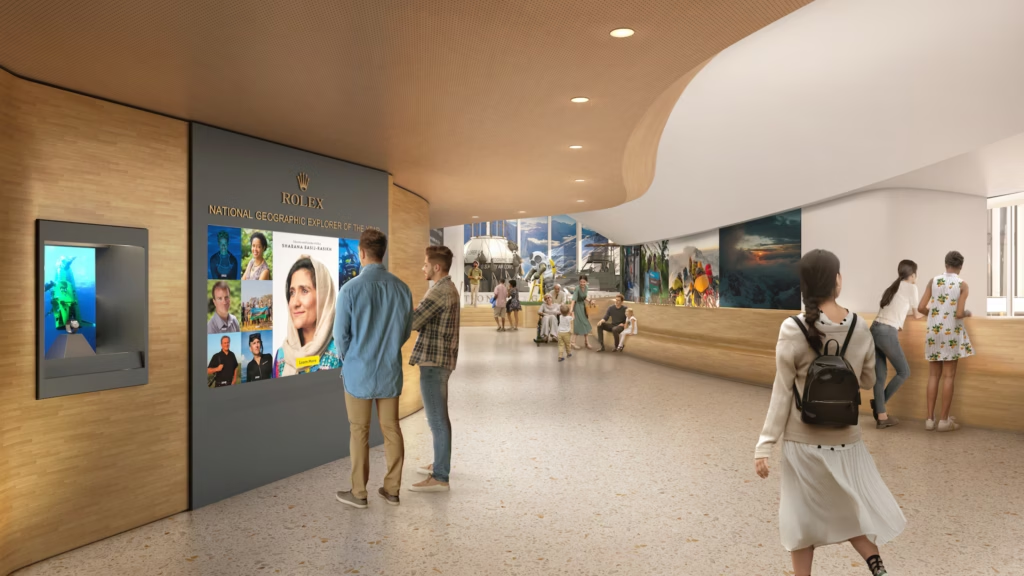
When the National Geographic Museum of Exploration opened in Washington, D.C. this summer, visitors walked through 100,000 square feet of exploration history: Jacques Cousteau’s diving saucer, the pressurized suit Sylvia Earle wore for her record untethered sea walk in 1979, and photographs from more than a century of expeditions. What they found almost none of was watches.
That’s notable, because the museum’s largest donor was a watchmaker. Rolex described itself simply as the Founding Donor and Grand Opening Partner. The scale of its support became public only when watch journalist Jason Heaton, previewing the museum for Hodinkee, reported that a donor plaque listed Rolex’s gift at $100 million. The National Geographic Society had called it by far the largest single gift in its 135-year history when it was announced in 2023, without naming the amount. According to Heaton, the only Rolex on display in the entire museum is the Deepsea Challenge from James Cameron’s submersible.
On September 22, during New York Climate Week, Rolex will premiere the sixth season of Planet Visionaries, its documentary-style podcast hosted by climber Alex Honnold. The launch caps a year of milestones for the watchmaker’s Perpetual Planet Initiative, though Rolex, true to form, has kept the focus on the work rather than itself. Together, those milestones point to a single idea: Rolex’s most enduring asset may be its integrity, built through characteristic modesty and decades of work behind the scenes.
A commitment older than the trend
Over the past decade, corporate sustainability has moved in waves. Pledges and purpose campaigns surged, then retreated as companies grew wary of greenwashing accusations and political backlash. GlobeScan found that only 36% of consumers saw sustainability messaging from brands in 2025, down from 49% in 2023, and trust in the messages that remain has fallen too.
Rolex’s commitment predates that cycle by nearly a century. In the 1930s, founder Hans Wilsdorf began sending watches with explorers to the most extreme places on Earth. In 1953, Rolex equipped the expedition that put Sir Edmund Hillary and Tenzing Norgay on the summit of Everest, and National Geographic’s coverage of the climb began a partnership that has now lasted more than 70 years.
Over time, the purpose of that exploration changed, from discovery for its own sake to protecting what explorers had found. In 2019, Rolex formalized that shift with the Perpetual Planet Initiative, which today spans more than 30 partners.
Letting others do the talking
What sets Rolex apart isn’t only the scale of its giving. It’s how little the company says about it.
Rather than commenting on its environmental work, Rolex lends its platform to the people doing it: oceanographer and Rolex Testimonee Sylvia Earle, whose Mission Blue has designated more than 160 ocean Hope Spots; Coral Gardeners founder and Rolex Testimonee Titouan Bernicot; and partners from Rewilding Argentina and Chile to explorer Steve Boyes’ Great Spine of Africa expeditions. Through its long-standing relationship with The Explorers Club, the Rolex Explorers Club Grant sends early-career researchers into the field. And as a partner to the OceanX Summit, held aboard the research vessel OceanXplorer in Singapore from October 7 to 9, Rolex joins the scientists, innovators and storytellers shaping the future of the ocean.
Rolex has also helped build the platforms that carry these stories. In 2019, it partnered with CNN to launch Call to Earth, a global initiative covering environmental challenges and the people working on solutions.
Planet Visionaries carries that approach into podcasting. Over five seasons, Honnold has interviewed Earle, actor Mark Ruffalo, SeaLegacy co-founders Cristina Mittermeier and Paul Nicklen, and conservationist Kris Tompkins. Season 6, produced by Sony Music Entertainment, runs 20 weekly episodes built around visual storytelling, on Rolex’s YouTube channel and major podcast platforms.
“This season of Planet Visionaries is about the people already doing that work every day,” Honnold said in a statement announcing the season. “Each guest saw a challenge and moved toward it, and their stories show just how much one person can set in motion.”
Why it matters now
The new season arrives as traditional outlets pull back from climate coverage. In February, The Washington Post laid off 74% of its climate desk, and CBS News no longer has a dedicated climate reporter. New York Times climate coverage has fallen 66% from its October 2021 peak, and global coverage dropped 14% in 2025.
But audience interest hasn’t faded, and podcasts are increasingly where these stories live, from HEATED’s new video podcast, produced by a former CBS News climate producer, to Drilled’s move to Pushkin Industries and the new season of Ayana Elizabeth Johnson’s What If We Get It Right?.
Rolex invested in the format before the latest wave of newsroom cuts, and has kept expanding it since. Planet Visionaries launched in 2021 as a four-part series and has grown into a 20-episode season built around video, one that gives its partners the microphone. Listeners respond to that approach: 61% say a branded podcast makes them more favorable toward the brand behind it.
Fifty years of backing people
Nowhere is Rolex’s consistency clearer than in the Rolex Awards, which celebrate their 50th anniversary this year. Created in 1976 as a one-time celebration of the Oyster, the first waterproof wristwatch, the Awards drew so much interest that Rolex kept them going. They have since supported 165 Laureates across more than 67 countries, whose projects have planted more than 50 million trees and protected 137 endangered species.
Some have changed their fields. Ophthalmologist Andrew Bastawrous turned a smartphone into a portable eye clinic across sub-Saharan Africa, and Felix Brooks-church’s flour fortification technology now delivers vital micronutrients to five million people in Tanzania.
This year’s Laureates, all women, are Pardis Sabeti (United States), Rachel Ikemeh (Nigeria), Rosa Vásquez Espinoza (Peru), Binbin Li (China) and Farwiza Farhan (Indonesia). All five appear on Planet Visionaries this season, alongside Krithi K. Karanth, the 2026 Rolex National Geographic Explorer of the Year.
Modesty as brand value
That consistency shows up in how the public sees the company. In RepTrak’s annual Global RepTrak 100, which measures corporate reputation across areas including citizenship, conduct and leadership, Rolex ranked first in the world in 2022 and placed in the top six every year from 2020 to 2025. RepTrak’s 2026 report found that consumers are placing greater emphasis on corporate behavior over corporate messaging, a shift that favors companies whose reputations rest on what they do rather than what they say.
That’s the paradox of Rolex’s approach. As other brands go quiet to avoid scrutiny, Rolex gains credibility precisely because it never made its commitment a marketing campaign. Decades of consistent support are difficult for competitors to replicate, and difficult for skeptics to dismiss.
Even Rolex’s disclosures have arrived quietly. Its sustainability report stayed internal for years before going public. It shows emissions down nearly 40% between 2021 and 2023, and about 70% of Rolex’s gold now reclaimed from its own production waste. Its 2025 key achievements include a new Swiss site aiming for the highest BREEAM green-building rating.
Rolex’s structure makes the long view possible. Privately owned by the Hans Wilsdorf Foundation, Rolex is free from quarterly earnings pressure and able to make commitments measured in decades rather than campaign cycles.
The result is a form of brand equity that doesn’t show up in advertising. It lives in a museum gallery that features explorers instead of watches, in a podcast that gives its airtime to scientists, and in fifty years of Laureates whose work has outlasted the sustainability trends around them.
In an era of loud pledges and strategic silence, Rolex has found a third path: do the work, support the people doing it, and let their stories speak.
Planet Visionaries Season 6 premieres September 22 on the Rolex YouTube channel, Apple Podcasts and Spotify.
RELATED ARTICLE: Tudor Expands Sustainability Program, Reinforces Ethical Watchmaking Goals
Matt Bird is the Founder, CEO, and Editor-in-Chief of ESG News. He brings 25 years of experience in corporate strategy, media, fintech, and communications, including 15 years specializing in news and journalism. Matt was recognized by the United Nations as #3 of the “Top 10 Most Influential Media Executives for Impact” in 2015 during the launch of the UN SDGs.
He has advised the Sustainable Stock Exchange initiative (SSEI), UNCTAD, and the UN, and hosts event coverage at the World Economic Forum, ADFW, Climate Week NYC, EU Parliament, COP, the Vatican, NASDAQ, NYSE, and more. Matt is a founding board member of the Humanity 2.0 Foundation, a Vatican-based NGO focused on identifying and removing impediments to human flourishing.
He previously rang the NASDAQ Closing Bell in honor of his partnership with NASDAQ OMX to launch the world’s first retail investor targeting and newswire monitoring platform with the NASDAQ Financial Services Group. Matt launched ESG News in 2021, leading coverage of more than 10,000 news stories as of 2026—and truly loves what he does.