

Day 1 at Climate Week NYC: Leaders Shift Focus to Delivery
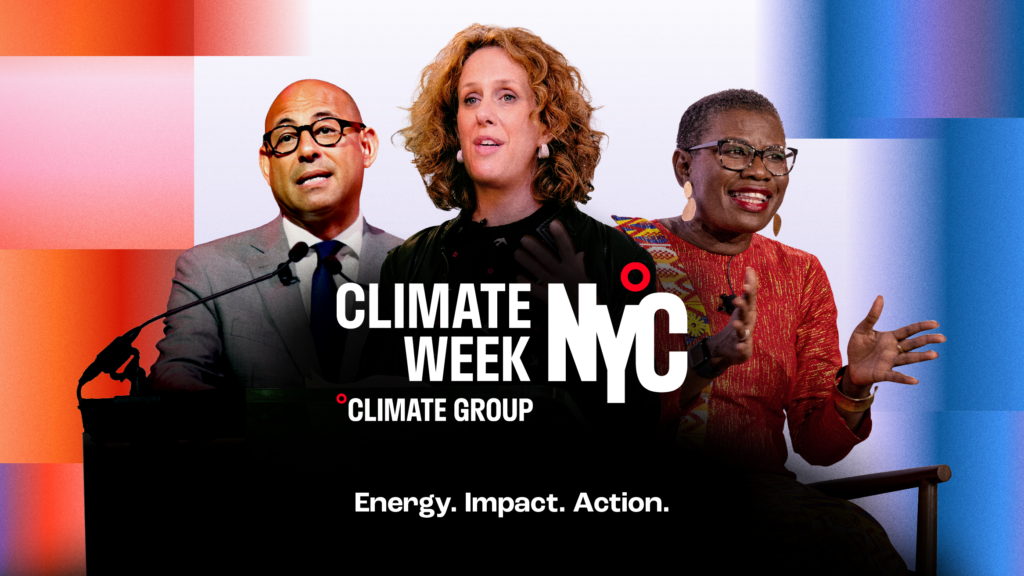
- Nigeria launched a $300 million clean energy fund, while new initiatives targeted freight decarbonization and the use of AI in climate action.
- Grid capacity emerged as a central concern as data centers, transport electrification and clean energy compete for infrastructure and power.
- Leaders pushed for faster implementation of existing technologies, arguing that finance, policy and infrastructure now matter as much as innovation.
Climate Week opened with a message that cut across government, business and civil society: much of the technology needed for the energy transition already exists. The harder task is deploying it quickly, affordably and at scale.
That challenge ran through discussions on renewable energy, artificial intelligence, transport, industrial decarbonization, methane and government resilience.
It also produced immediate commitments. Nigeria launched a $300 million clean energy fund focused on expanding access to off-grid power. Türkiye’s COP31 delegation announced a global initiative exploring how artificial intelligence can support climate progress.
Climate Group’s EV100 also announced a partnership with Smart Freight Centre. The initiative will target freight decarbonization, beginning in Mexico and South Africa.
Helen Clarkson OBE, CEO of Climate Group, framed the consequences of delayed action in stark terms. “Silence isn’t neutral, it’s dangerous. Silence enables inaction, and inaction leads to more climate change. More flooding, more fires, more empty supermarket shelves, more pollution, more uninsurable homes.”

Power demand puts grids under pressure
The collision between rising electricity demand and aging grid infrastructure emerged as one of the day’s clearest business risks.
BloombergNEF’s Stephanie Diaz said data centers are on course to add 118 GW of demand to the US grid by 2030. They could account for around 12% of average US electricity demand by then and roughly one-fifth by 2035.
That expansion is forcing utilities, technology companies and policymakers to confront questions about where new data centers are built and how they are powered.
PG&E Chief Sustainability Officer Aaron Johnson argued that existing infrastructure has more flexibility than headline capacity figures suggest. “The electric grid is only used 45% of the time.”

Congestion tends to occur during limited periods, creating opportunities for batteries, better software and smarter siting of large electricity users. However, equipment shortages and manufacturing constraints remain significant barriers to rapid grid expansion.
The same challenge is appearing in transport. Speakers called for charging infrastructure to become part of grid planning rather than arriving after electric vehicle demand materializes.
Uruguay provided evidence of how quickly adoption can change electricity needs. Seven in ten new vehicles sold there in August were fully electric, according to figures cited during the event.
RELATED ARTICLE: Climate Week NYC Opening Ceremony: Key Principles for Climate Action—Who, What & Why
Investment shifts toward implementation
Across the sessions, speakers repeatedly returned to the gap between available capital and investable projects.
India offered one example of how policy can narrow that divide. The country has expanded non-fossil power capacity roughly fourfold since 2014, according to speakers from the International Solar Alliance and Indian government.
Policy measures have reduced project risk and improved bankability for international investors. Corporate demand is also playing a growing role in supporting renewable deployment.
Yet supply-chain concentration remains a concern. Clean energy manufacturing continues to cluster in relatively few markets, exposing developers to geopolitical and trade risks.
Energy efficiency received similar attention. Executives argued that governments should treat efficiency alongside generation and transmission when planning future energy systems. Existing motors, cooling equipment and building technologies can reduce demand without waiting for major technological breakthroughs.
Climate policy meets economic and political reality
The discussions also moved beyond technology.
Government resilience, industrial jobs and public support featured prominently as leaders considered how climate policy can survive tighter budgets and political uncertainty.
A new Apolitical survey presented during the event found that only one in six public servants believes their government is prepared for coming climate impacts. The findings accompanied the launch of a government resilience campus aimed at strengthening public-sector capacity.
The transition’s impact on workers was another recurring theme. Speakers from labor, government and environmental organizations argued that industrial policy must pair decarbonization with well-paying employment and stronger domestic supply chains.
Rwanda’s Environment Minister Bernadette Arakwiye captured the broader implementation challenge: “True partnership requires an implementable plan, clarity on roles, and accountability. It has to deliver results on the ground.”

That may be the clearest takeaway from Climate Week’s opening discussions. Governments and companies are no longer debating only which technologies can cut emissions.
The harder questions concern who finances them, where infrastructure gets built and whether grids can accommodate rapidly changing demand. For executives and investors, execution risk is increasingly becoming climate strategy itself.

The ESG News Editorial Team is comprised of veteran financial journalists and sustainability analysts dedicated to providing real-time, objective reporting on global ESG regulations, climate finance, and corporate governance. Our desk monitors daily developments from the SEC, IFRS, CSRD and international regulatory bodies to ensure our 1M+ readers receive accurate, data-driven insights into the evolving sustainable investment landscape. Follow the ESG News Editorial Team for expert reporting on global sustainability standards, ESG disclosures, and climate policy. Access over 10,000 investigative reports and real-time updates.


