
Amazon’s 50,000 Electric Delivery Vans Put Corporate Climate Pledges to the Test
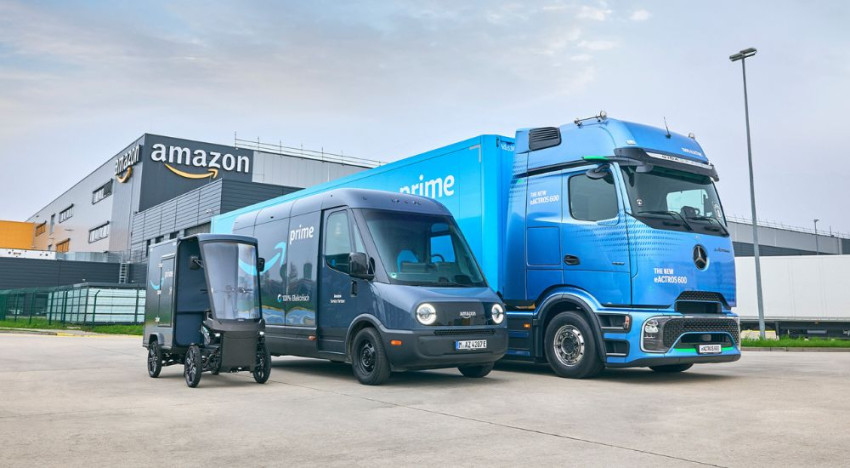
- Amazon’s global electric delivery fleet has crossed 50,000 vans, delivering more than 2.4 billion packages with zero exhaust emissions in 2024, halfway to its 100,000-vehicle target by 2030.
- In Europe, over 10,000 electric vans are now operational, backed by a €1 billion decarbonisation investment and a micromobility network spanning 70 hubs across 50+ cities.
- Ocean and rail now carry 35% of Amazon’s long-distance European inventory transfers, with 170 million packages moved by sea and rail in 2025, a 45% year-on-year increase.
Fleet Scale Meets Climate Accountability
At a moment when corporate net-zero commitments face growing scrutiny from regulators and investors alike, Amazon has put a concrete number on its progress: 50,000 electric delivery vans now operational worldwide. The figure, disclosed this month, places the company at the midpoint of a 100,000-vehicle target it set for 2030 when it co-founded The Climate Pledge in 2019, a commitment to reach net-zero carbon across operations a decade ahead of the Paris Agreement’s business timeline.
Together, those vans delivered over 2.4 billion packages last year without exhaust pipe emissions. For ESG analysts tracking Scope 1 and Scope 3 logistics emissions, the operational scale matters as much as the headline number. Delivery transport is notoriously difficult to decarbonise at volume. Amazon’s fleet data, covering multiple geographies and third-party delivery partners, offers a rare case study in what industrial electrification looks like beyond the pilot stage.
Europe as Proving Ground
Europe is where Amazon’s electrification strategy is most visible. At the close of 2025, more than 10,000 electric vans were operating across the continent, supported by a €1 billion investment in transportation decarbonisation announced in 2022. The company’s single largest European electric vehicle deployment came last year: nearly 5,000 Mercedes-Benz vans entering the network across Austria, France, Germany, Italy, and the United Kingdom, manufactured in Germany and Spain.
That partnership is not incidental. It reflects a deliberate choice to anchor procurement in European manufacturing, an alignment with the EU’s industrial decarbonisation agenda that carries both supply chain and political logic. Charging infrastructure has followed the vehicles: tens of thousands of charging points are now installed across Amazon’s global facilities, including thousands across Europe.
The company has positioned this build-out as an accelerant for broader public charging investment, arguing that visible corporate deployment can shift the calculus for infrastructure developers and municipal planners alike.
Micromobility Closes the Urban Last Mile
Beyond vans, Amazon has been quietly building a parallel network for dense urban environments. Since launching the first electric cargo bike delivery in 2017, it has expanded to more than 70 micromobility hubs across 50-plus European cities, using electric cargo bikes, electric mopeds, and on-foot pushcart delivery.
In 2025 alone, over 30 million deliveries were completed using these methods, bringing the European cumulative total to more than 100 million. The emissions avoided to date, calculated at more than 17,000 metric tons of carbon dioxide equivalent, translate to removing roughly 3,900 petrol cars from the road for a year. In cities with restricted traffic zones and narrow historic centres, these are not workaround solutions. They are frequently the fastest and most compliant delivery method available.
RELATED ARTICLE: Amazon Tests Next-Gen Decarbonization Strategies at New Indiana Facility
Heavy Goods and Modal Shift
Electrification is extending beyond the final mile. Amazon now operates more than 100 electric heavy goods vehicles in its European middle-mile network, the freight lanes connecting fulfilment centres, sort facilities, and delivery stations, and is tracking to more than double that fleet by end of 2026.
The modal shift strategy adds a further dimension. Amazon now moves European inventory via more than 500 sea and rail routes, twice the number from three years ago, cutting carbon intensity on those corridors by nearly 50% versus road transport. In 2025, over 35% of inventory transfers on lanes longer than 500 kilometres moved by sea or rail. A notable development: Amazon launched parcel transport on France’s TGV high-speed rail network, with over half a million packages travelling by high-speed rail in 2025.
Ocean freight accounted for 97% of Amazon’s imported transoceanic retail shipments last year, up from 90% the year prior. The direction of travel is consistent and measurable.
The Hard-to-Abate Gap
Where electrification is not yet viable, Amazon is turning to lower-carbon fuels as a bridge. In 2025, the company procured more than 14 million gallons of blended sustainable aviation fuel for its direct air operations. For ocean shipping and aviation, sectors where battery technology remains impractical at commercial scale, fuel procurement sends demand signals that influence investment decisions further up the supply chain.
What Executives and Investors Should Watch
For C-suite leaders and institutional investors, the practical takeaway is structural. Amazon’s approach rests on three simultaneous tracks: efficiency gains through network regionalisation, electrification where infrastructure supports it, and fuel transition where it does not. The 500-plus European sea and rail routes, the micromobility hubs, and the heavy goods electrification pipeline are evidence that the strategy extends beyond passenger vans and press releases.
The 50,000-van milestone is a datapoint, not a destination. With the 2030 target still 50,000 vehicles away and Scope 3 reporting pressure intensifying under EU and SEC frameworks, the question for competitors, logistics providers, and fleet operators is no longer whether electrification is viable at scale. Amazon has answered that. The question now is how quickly everyone else can close the gap.

The ESG News Editorial Team is comprised of veteran financial journalists and sustainability analysts dedicated to providing real-time, objective reporting on global ESG regulations, climate finance, and corporate governance. Our desk monitors daily developments from the SEC, IFRS, CSRD and international regulatory bodies to ensure our 1M+ readers receive accurate, data-driven insights into the evolving sustainable investment landscape. Follow the ESG News Editorial Team for expert reporting on global sustainability standards, ESG disclosures, and climate policy. Access over 10,000 investigative reports and real-time updates.