Live Nation–Ticketmaster Found Guilty of Illegal Monopoly: A Major ESG Governance Failure
Category: ESG Governance | Date: April 15, 2026 | Read time: 6 min
A federal jury has ruled that Live Nation Entertainment operated an illegal monopoly in the live events industry. The verdict is a landmark case study in corporate governance failure — and a warning signal for ESG-focused investors.
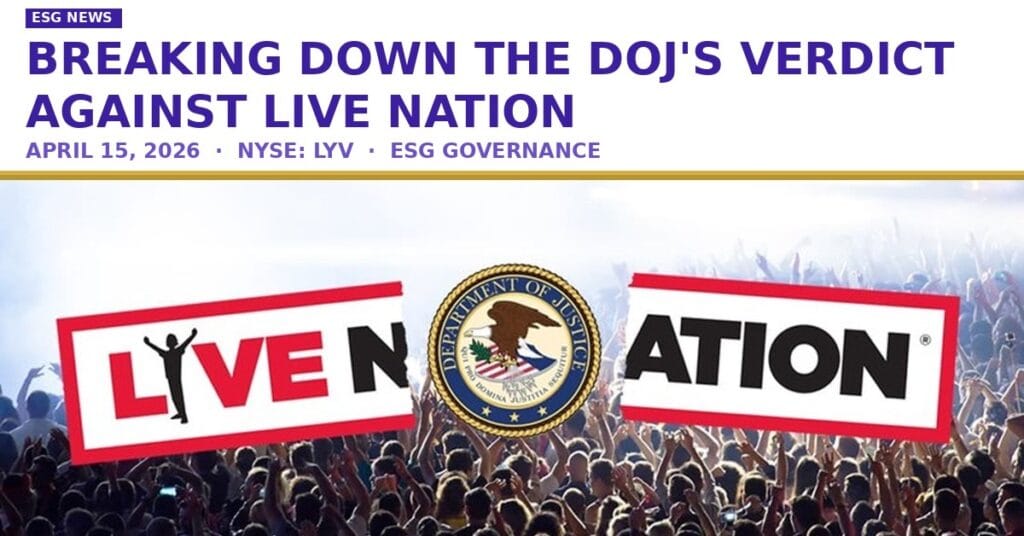
On April 15, 2026, a federal jury found that Live Nation Entertainment (NYSE:LYV) — parent company of Ticketmaster — had operated an illegal monopoly across the live entertainment sector. The ruling covers ticketing, concert promotion, and venue management.
The case was brought by the U.S. Department of Justice, joined by more than 30 state attorneys general. It marks one of the most significant antitrust rulings against a U.S. entertainment company in decades.
“The verdict confirms what artists, fans, and independent venues have argued for years — that Live Nation used its dominance not to compete, but to coerce.”
Why This Is a Governance (G) ESG Story
Anticompetitive conduct at the board level
The core of this verdict is a failure of corporate governance. Live Nation built what the DOJ called a “flywheel” Live Nation monopoly— an interlocking system where its dominance in venues, promotion, and ticketing reinforced itself. Rather than competing on merit, the company allegedly leveraged that dominance to block rivals.
This is precisely the kind of risk that ESG governance frameworks are designed to detect. Strong boards set clear policies against anticompetitive behavior. They implement internal controls. They ask hard questions about how market position is maintained.
Internal messages revealed a culture problem
Evidence presented at trial included internal communications in which employees boasted about “robbing” customers. This language is not just colorful. It signals a deeper cultural failure — one that should concern any board member, compliance officer, or institutional investor.
When employees celebrate predatory pricing in writing, it points to weak ethical oversight, poor management incentives, and a tone set from the top that tolerates — or even encourages — harmful behavior.
Live Nation violated its own consent decree
In 2010, to prevent Live Nation from becoming a monopoly, the DOJ approved Live Nation’s merger with Ticketmaster under a consent decree — a legally binding set of behavioral conditions. The government alleged at trial that Live Nation violated those conditions repeatedly, including through a 2019 updated agreement.
This is a textbook governance failure. Compliance with regulatory obligations is a basic function of board oversight. A company that breaches a consent decree has failed at the most fundamental level of legal risk management.
Key governance failures identified at trial
- Monopolistic control over venues, ticketing, and concert promotion
- Internal culture that normalized predatory pricing
- Alleged repeated violation of a 2010 DOJ consent decree
- Failure of compliance and internal risk management systems
- Board-level absence of ethical guardrails on competitive conduct
The Social (S) Dimension: Fans, Artists, and Venues
Consumers paid the price
The human cost of monopoly power is real. Fans have faced excessive service fees, high resale prices, and limited choice in purchasing platforms. The DOJ characterized these outcomes as direct results of Live Nation’s unchecked market power.
For ESG analysts, consumer harm is a material social risk. Companies that exploit captive customers face regulatory backlash, reputational damage, and eventual revenue loss when public trust erodes.
Artists and independent venues were squeezed
The trial testimony also revealed how Live Nation allegedly pressured artists and independent venues. Those who did not use Ticketmaster risked being shut out of major touring opportunities. This coercive dynamic stifled competition and harmed smaller players across the entire live music ecosystem.
This “bully the supply chain” dynamic — using size and leverage to force compliance — is a pattern that ESG social risk frameworks flag as a warning sign for long-term business model sustainability.
What Happens Next: Remedies and Investor Risk
 A structural breakup is now on the table
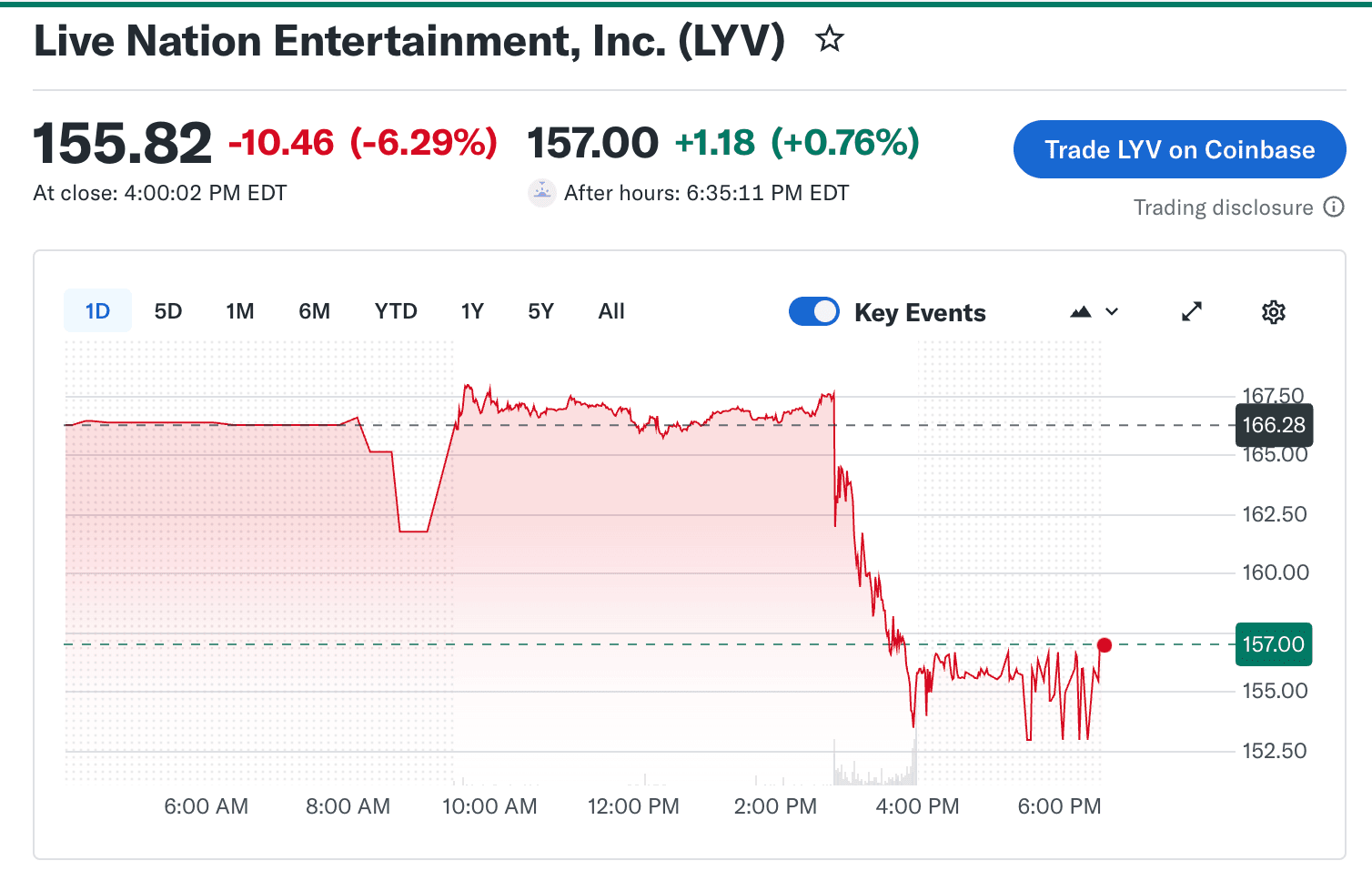
The verdict opens the door to significant structural remedies. The DOJ has long sought a forced separation of Ticketmaster from Live Nation. If a judge orders such a breakup, it would fundamentally alter the company’s revenue model, market power, and stock valuation.
ESG investors should model this scenario seriously. A structural separation is not a tail risk — it is now a plausible near-term outcome.
30-plus states rejected the federal settlement
One underreported dimension of this case is the breadth of state-level opposition. More than 30 state attorneys general — spanning red and blue states — rejected a proposed federal settlement and pushed for trial. This cross-partisan consensus amplifies the reputational and regulatory risk facing Live Nation far beyond a single federal ruling.
For governance-focused investors, this signals that the company’s legal exposure is not limited to one jurisdiction or administration. It is systemic.
“A court-ordered breakup of Ticketmaster and Live Nation would be one of the most consequential corporate governance restructurings in modern U.S. entertainment history.”
RELATED ARTICLE: Ikea Takes On Ebay With New Secondhand Marketplace
Long-term materiality for ESG portfolios
This verdict is materially significant for ESG-focused institutional investors. Consider the exposure: legal costs from an ongoing trial, potential structural remedies, reputational damage with artists and consumers, and a business model now under formal judicial scrutiny.
ESG portfolios with live entertainment exposure should reassess holdings in Live Nation and monitor upcoming sentencing and remedy hearings closely.
ESG Takeaways for Corporate Governance Practitioners
The Live Nation–Ticketmaster monopoly verdict offers a clear lesson. Monopoly power does not insulate a company from governance risk. In fact, it concentrates it. When a single entity controls an entire industry ecosystem, every ethical failure is amplified — and every compliance gap becomes a systemic vulnerability.
Boards and governance committees should use this case as a prompt to audit three things: how competitive conduct is incentivized internally, whether compliance functions have genuine independence, and how the company would perform under expanded regulatory scrutiny.
ESG investor action checklist
- Review Live Nation holdings against antitrust and governance screens
- Monitor remedy and sentencing hearings for breakup risk signals
- Engage Live Nation’s board on compliance program reforms
- Assess exposure to other vertically integrated entertainment platforms
- Update governance ESG scoring models to include consent decree compliance
This article is for informational purposes only and does not constitute legal or investment advice. ESG News covers ESG, sustainability, governance, and responsible investment topics.

The ESG News Editorial Team is comprised of veteran financial journalists and sustainability analysts dedicated to providing real-time, objective reporting on global ESG regulations, climate finance, and corporate governance. Our desk monitors daily developments from the SEC, IFRS, CSRD and international regulatory bodies to ensure our 1M+ readers receive accurate, data-driven insights into the evolving sustainable investment landscape. Follow the ESG News Editorial Team for expert reporting on global sustainability standards, ESG disclosures, and climate policy. Access over 10,000 investigative reports and real-time updates.