Hong Kong, Dongguan To Build Greater Bay Area’s First SAF Supply Chain
- EcoCeres plans a major Dongguan facility producing around 450,000 tonnes of SAF and Hydrotreated Vegetable Oil annually.
- The project supports Hong Kong’s target for departing flights at Hong Kong International Airport to use a proportion of SAF by 2030.
- The partnership ties aviation decarbonisation to China’s dual-carbon goals and the National 15th Five-Year Plan.
Hong Kong and Dongguan are moving to build the Greater Bay Area’s first full sustainable aviation fuel supply chain, linking airport decarbonisation, industrial policy and cross-border green investment.
The Government of the Hong Kong Special Administrative Region and the Dongguan Municipal Government have agreed to deepen strategic cooperation on sustainable aviation fuel, or SAF. The plan is designed to cover the full value chain, from feedstock collection to production, blending and refuelling.
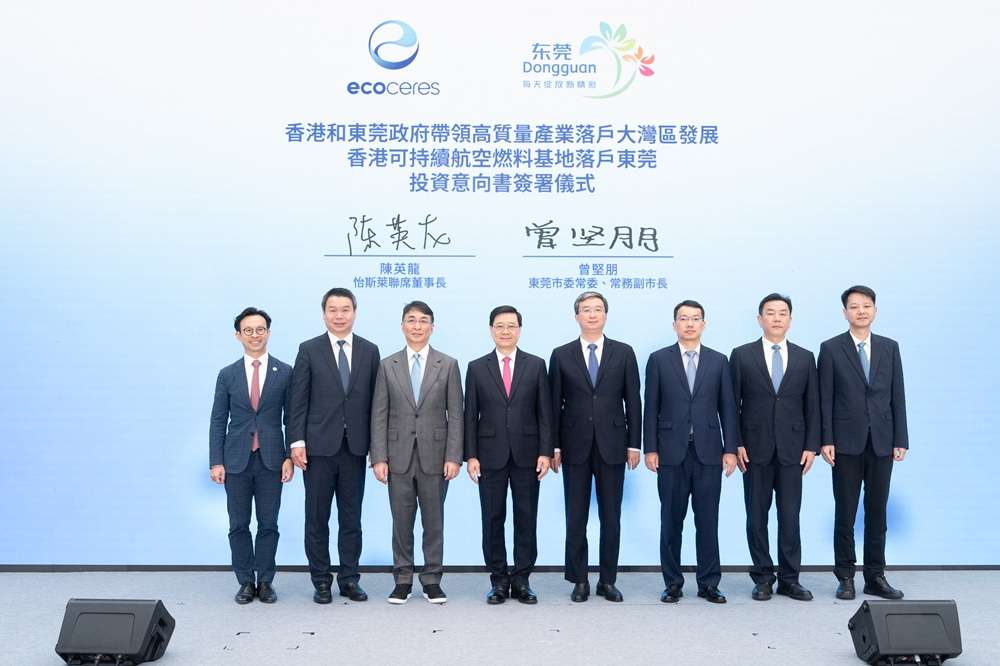
At the centre of the agreement is EcoCeres, a Hong Kong-incubated sustainable fuels producer founded by Towngas. Under the Hong Kong SAR Government’s leadership, EcoCeres signed an Investment Letter of Intent with the Dongguan Municipal People’s Government to establish a major new SAF facility in Dongguan.
The signing ceremony was attended by Hong Kong SAR Chief Executive John Lee, senior Dongguan officials and EcoCeres leadership.
Lee said the project aligns with the National 15th Five-Year Plan and demonstrates effective collaboration between Hong Kong and Dongguan to advance green development and support China’s dual-carbon goals.
Dongguan Plant To Anchor Regional Fuel Production
EcoCeres’ planned Dongguan facility is expected to produce around 450,000 tonnes of SAF and Hydrotreated Vegetable Oil each year. That scale would make the plant a core production hub for the Greater Bay Area’s emerging low-carbon aviation fuel market.
The project also links industrial capacity with aviation demand. Hong Kong International Airport is one of Asia’s major global aviation hubs, and the Hong Kong SAR Government has committed to accelerating green technology adoption across the transport sector.
The initiative supports the government’s target for departing flights at Hong Kong International Airport to use a proportion of SAF by 2030. For airlines, that matters because SAF remains one of the few near-term pathways to cut emissions from long-haul aviation without replacing aircraft fleets.
The proposed model is not limited to fuel production. It aims to create an integrated SAF ecosystem across waste-based feedstock collection, conversion, blending and delivery into the aviation fuel supply chain.
That integration is important for investors and operators. SAF projects face high capital costs, limited feedstock availability and uncertain demand. A regional supply chain can reduce some of those risks by aligning policy support, industrial infrastructure and aviation offtake.
RELATED ARTICLE: SAF One Secures Up To $30 Million For Middle East SAF Project
Policy And Industrial Strategy Drive The Deal
The Hong Kong-Dongguan partnership reflects a wider shift in Asia’s decarbonisation strategy. Governments are no longer treating SAF as a niche aviation product. They are positioning it as part of industrial policy, transport security and green finance.
Wei Hao, Secretary of the CPC Dongguan Municipal Committee, highlighted the long-standing partnership between the two cities and said EcoCeres’ decision reflects confidence in Dongguan’s industrial strengths and its role in the global low-carbon transition.
Dongguan brings manufacturing depth and industrial infrastructure. Hong Kong brings aviation demand, finance, international connectivity and a policy push to position itself as a green technology and sustainable finance hub.
EcoCeres adds technical capacity. The company is already one of the world’s largest SAF producers and uses waste-based feedstock to deliver significant emissions reductions. Its role gives the project a stronger commercial foundation than an early-stage pilot.
For the C-suite, the message is clear. SAF is moving from voluntary climate procurement into strategic infrastructure. Airlines, fuel suppliers, airports and logistics groups will need credible access to lower-carbon fuels as climate targets tighten and disclosure expectations grow.
Greater Bay Area Seeks Global SAF Leadership
The Greater Bay Area has the scale to influence SAF markets beyond southern China. It combines major ports, airports, manufacturing centres and financial institutions across Hong Kong, Shenzhen, Guangzhou, Dongguan and surrounding cities.
If the EcoCeres facility advances as planned, it could strengthen the region’s position in sustainable aviation fuel while supporting China’s broader carbon strategy. It also gives Hong Kong a more concrete route to link aviation growth with climate commitments.
The project’s broader significance lies in execution. SAF demand is growing, but supply remains constrained. The regions that build dependable production, logistics and refuelling systems first will have an advantage.
For Hong Kong and Dongguan, the proposed supply chain is not only a green fuel project. It is a test of whether regional cooperation can turn climate policy into bankable industrial capacity, with implications for aviation decarbonisation across Asia and global transport markets.

The ESG News Editorial Team is comprised of veteran financial journalists and sustainability analysts dedicated to providing real-time, objective reporting on global ESG regulations, climate finance, and corporate governance. Our desk monitors daily developments from the SEC, IFRS, CSRD and international regulatory bodies to ensure our 1M+ readers receive accurate, data-driven insights into the evolving sustainable investment landscape. Follow the ESG News Editorial Team for expert reporting on global sustainability standards, ESG disclosures, and climate policy. Access over 10,000 investigative reports and real-time updates.