Market Signals: ESG ETF & Clean Energy ETF Briefing — April 17, 2026
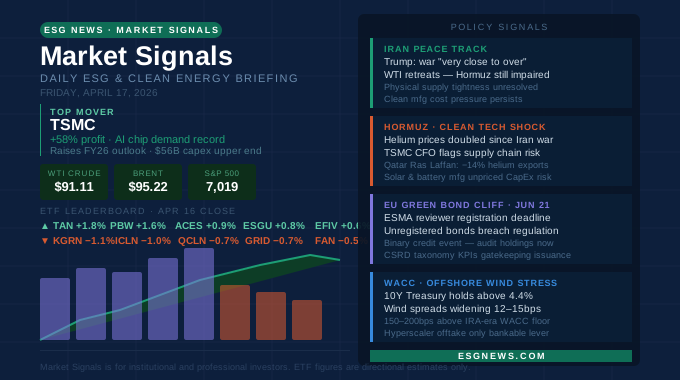
ESG News · ESG ETF Market Signals · Friday, April 17, 2026 Data reflects Thursday, April 16, 2026 close · For risk desks & institutional investors
Yesterday’s ESG ETF session delivered a split verdict for ESG allocators: the S&P 500 slipped 0.3% and the Nasdaq-100 shed 0.23% after both indices had set record closes Wednesday, as mixed mega-cap earnings and geopolitical recalibration suppressed risk appetite into the close. The dominant macro trade — Trump-Iran peace signals compressing oil, TSMC’s AI-fueled blowout print confirming behind-the-meter power demand at scale, and Netflix’s guide-down rattling sentiment after hours — left clean energy desks navigating a bifurcated tape where AI-power infrastructure held firm while EV and offshore wind names gave ground.
📊Daily ESG ETF Leaderboard · April 16, 2026 Close
▲ Top 5 Performers
- TAN — Invesco Solar ETF — +1.8%
- PBW — Invesco WilderHill Clean Energy ETF — +1.6%
- ACES — ALPS Clean Energy ETF — +0.9%
- ESGU — iShares ESG Aware MSCI USA ETF — +0.8%
- EFIV — SPDR S&P 500 ESG ETF — +0.6%
▼ Bottom 5 Performers
- ICLN — iShares Global Clean Energy ETF — −1.0%
- QCLN — First Trust Nasdaq Clean Edge Green Energy Index Fund — −0.7%
- GRID — First Trust Nasdaq Clean Edge Smart Grid Infrastructure ETF — −0.7%
- FAN — First Trust Global Wind Energy ETF — −0.5%
- KGRN — KraneShares MSCI China Clean Technology ETF — −1.1%
† Leaderboard reflects directional analyst estimates derived from April 16 session catalysts and confirmed sector moves; verify against official NAV before execution.
🟢Top ESG ETF Movers Breakdown
🔆 TAN & PBW (+1.8% / +1.6%) — Solar and broad clean energy outperformed on the dual tailwind of oil’s continued retreat on Iran peace-deal hopes and TSMC’s earnings blowout — Iran diplomacy progress compressed utility power costs and improved solar project IRRs simultaneously, while TSMC’s 58% profit surge and raised capex guidance confirmed AI data center electricity demand is accelerating, not decelerating. IRA Section 45X manufacturing credits continue to provide a structural floor for TAN’s top holdings including First Solar and Enphase, independent of near-term policy noise.
🔋 ACES (+0.9%) — The North American-only mandate shielded the fund from global trade noise hammering Chinese and European-exposed peers — its higher allocation to regulated clean power operators like Clearway Energy and Brookfield Renewable Partners gave ACES a utility-grade floor as Fed rate-cut expectations remained intact. The fund’s flat concentration profile — no single holding above 5.7% — further insulated it from single-stock volatility on a choppy tape.
📈 ESGU & EFIV (+0.8% / +0.6%) — Broad U.S. large-cap ESG screens caught an institutional quality-factor bid heading into the weekend — TSMC’s AI capex upgrade to the upper end of its $56 billion guidance range signaled sustained semiconductor and data infrastructure spend, lifting the mega-cap ESG names that dominate both funds. EFIV has now gained four consecutive sessions, reflecting durable institutional demand for S&P-proximate ESG exposure as earnings season reinforces the macro soft-landing case.
🔴Laggard ESG ETF Breakdown
🌍 ICLN & FAN (−1.0% / −0.5%) — Global mandate exposure proved the session’s primary liability — European wind and solar names were dragged by continued Strait of Hormuz supply chain uncertainty and rising embedded energy cost structures, with the Strait effectively closed since March 4 and threatening critical material supply lines across the clean tech value chain. ICLN’s international diversification — a relative-value asset in prior sessions — became a liability as geopolitical risk repriced European utility exposure on a risk-off close.
⚡ GRID (−0.7%) — High-P/E transition infrastructure sold off into the close despite being a structural AI power beneficiary — Netflix’s after-hours guide-down seeded a broader risk-off rotation out of expensive thematic names, and GRID’s capital-intensive buildout thesis remains contingent on a Fed cut that the market is no longer pricing before Q3. Elevated WACC assumptions of 150–200bps above 2022 IRA-era baselines continue to suppress new project finance structures.
🇨🇳 KGRN (−1.1%) — Led the laggard board as U.S.-China trade friction and domestic overcapacity pressures converged — anti-dumping rhetoric in both Brussels and Washington hit Chinese clean tech valuations simultaneously, while a persistent glut in Chinese solar panel supply continues to compress margins for KGRN’s core holdings. The fund’s dual exposure to geopolitical risk and sector oversupply creates a structural headwind that near-term oil moves alone cannot offset.
🔌 QCLN (−0.7%) — EV-adjacent weighting acted as a drag on an otherwise constructive clean energy session — Tesla and Rivian exposure lagged on continued uncertainty over IRA EV credit durability under the current legislative cycle, and QCLN’s heavy Bloom Energy position required no fresh catalyst after last week’s Oracle deal surge; profit-taking in the top holding added incremental pressure. The fund’s concentration risk — top five holdings comprising over 40% of AUM — amplified the session’s downside.
🌍 Geopolitical & Policy Signals
🕊️ Iran Peace Track Accelerates — Oil Retreats, But Hormuz Remains Functionally Impaired — President Trump declared the Iran war “very close to over” in a Fox Business interview, driving WTI and Brent lower on ceasefire optimism, while Goldman Sachs simultaneously warned that geopolitical risks remain the primary threat to global economic growth through energy supply shocks and market volatility. A full Hormuz reopening would compress energy input costs for clean manufacturing, cutting LCOE for solar and onshore wind projects that have absorbed 12–18% embedded cost inflation since March — but physical transit through the Strait remains at a fraction of pre-war vessel volume, and futures pricing has not yet resolved the physical supply tightness.
🏭 TSMC Hormuz Warning Flags a Clean-Tech Supply Chain Shock Beyond Oil — TSMC’s CFO flagged potential long-term profitability impacts from the Strait closure on the April 16 earnings call, noting it is a vital gateway for chipmaking chemicals including helium, with Qatar’s Ras Laffan complex supplying roughly a third of global helium and warning exports could fall 14% — helium prices have already doubled since the Iran war began. Thin-film solar and advanced battery manufacturers source the same rare gas streams; this is a stealth CapEx shock for domestic clean tech manufacturing that is not yet priced into ESG thematic ETFs.
⚡ TSMC’s AI CapEx Raise Is the Quarter’s Biggest ESG Power Demand Catalyst — TSMC raised its 2026 revenue growth outlook to above 30% on the April 16 call and pushed capex guidance toward the upper end of its $52–56 billion range, cementing multi-gigawatt incremental electricity demand that directly backstops U.S. grid-scale solar and battery storage PPAs through 2028. Every major AI chip — NVIDIA’s accelerators, Apple’s custom silicon, AMD’s data center GPUs — runs through TSMC fabs, making this the single most important confirmed demand signal for clean power infrastructure investors this earnings cycle.
RELATED ARTICLE: Market Signals: ESG & Clean Energy ETF Briefing — April 15, 2026
🚨 Global Regulatory Alarm
Note: No new regulatory enforcement actions or major policy filings were identified as direct April 16 session catalysts. The following reflects active structural conditions that this briefing is establishing as standing baseline context for ongoing Market Signals coverage — these are background conditions, not fresh triggers.
🟦 CSRD: 1,100+ Early Filings Signal the Compliance Regime Is Now Structurally Embedded — More than 1,100 early CSRD filings confirm the shift from voluntary sustainability communications to formal regulatory discipline is no longer theoretical; multinationals including Bayer are now publishing CSRD-compliant disclosures alongside supplementary SASB, TCFD, and SFDR documents as a dual-reporting standard. EU Taxonomy KPI templates updated January 1, 2026 require materiality-focused disclosures, and taxonomy alignment is hardening as a green bond issuance gatekeeping criterion — issuers without credible taxonomy KPI documentation are seeing primary market execution risk rise.
🇦🇪 UAE Scope 1–3 Enforcement Cycle Active: $500K+ Penalties Now Live — The UAE’s mandatory emissions monitoring regime — covering all companies including free zones since May 2025 — has entered active enforcement, with noncompliance penalties exceeding $500,000 and escalating repeat-offense fines. This is a material jurisdiction risk for multinationals using UAE SPVs in green bond or project finance structures linked to GCC transition assets; risk desks with GCC credit book exposure should immediately verify Scope 3 reporting certification for all UAE-domiciled issuers.
🇺🇸 U.S. Disclosure Fracture: Three-Jurisdiction Compliance Stack Now Operational — SEC climate rules remain stayed and undefended since March 2025, while California’s SB 253 mandatory Scope 3 disclosure proceeds on its own enforcement timeline and EU CSRD imposes mandatory double-materiality on covered non-EU companies — creating a three-jurisdiction compliance stack that U.S.-listed multinationals must manage simultaneously. A Morningstar survey found 46% of global asset owners view U.S./EU regulatory rollbacks as a step in the wrong direction, signaling continued institutional ESG disclosure pressure independent of federal mandate.
💳 Credit & Capital Signals
Note: No confirmed intraday shifts in green bond pricing or transition debt spreads were directly observed in Thursday’s session. The following reflects active financing conditions and a confirmed corporate credit development with a direct April 16 hook.
💵 Bloom Energy/Oracle AI Power Deal — The Clean-Tech Credit Template of 2026 — The 2.8 GW Bloom/Oracle fuel cell offtake structure — confirmed and re-rated by markets following last week’s announcement — transforms Bloom from a speculative clean power issuer into an investment-grade revenue-visibility story, establishing hyperscaler offtake as the credit anchor that unlocks transition debt at tighter spreads. For green bond desks, this is the “Zelestra/Meta PPA” template applied to distributed generation — the most significant clean-tech corporate credit structure of the year, and the model against which all new behind-the-meter issuance will now be benchmarked.
📉 Offshore Wind Transition Debt: Structural WACC Headwind Persists — Ongoing condition, not a new April 16 development. With 10-year Treasury yields holding above 4.4%, project-level WACC for greenfield wind and solar remains 150–200bps above 2022 IRA-era assumptions, making investment-grade hyperscaler offtake the only reliable mechanism compressing blended cost of capital to bankable levels. The softer-than-expected March PPI print has modestly reduced tail risk of a Fed hike, providing limited spread support for transition debt — but the structural WACC headwind will not clear until the 10-year pulls meaningfully below 4%.
Desk Note (Unverified): Market participants are monitoring potential tightening of AI-adjacent green bond spreads following the TSMC capex raise, though no confirmed primary market issuance moves were observed in Thursday’s session.
⚖️ Regulatory & Compliance Signals
🇮🇹 Italian Court Netflix Ruling: An EU Enforcement Template ESG Desks Cannot Ignore — An Italian court ruled in April 2026 that Netflix’s multi-year price hikes from 2017–2024 were unlawful, with potential refunds to millions of users of up to €500 each — the ESG compliance signal is direct: EU consumer regulators are demonstrably willing to apply retroactive enforcement on corporate conduct across sectors, including sustainability-linked pricing representations and disclosure claims. Risk desks with EU consumer-facing portfolio companies should treat this ruling as a leading indicator of greenwashing litigation exposure, not an isolated media sector event.
🌿 EU Green Bond Technical Standards Now Operational — Taxonomy KPIs Gatekeeping Issuance — The European Commission’s March 2026 Delegated Regulation introducing technical standards for assessing environmental performance under the EU Green Bonds Regulation is now in force, with taxonomy alignment hardening as a primary market execution requirement. Issuers without credible taxonomy KPI documentation are already seeing primary market execution risk rise; the ESMA reviewer registration deadline of June 21 compounds this into a dual compliance cliff for Q2 issuance pipelines.
Desk Note (Unverified): Market participants are monitoring the EFRAG voluntary standard engagement process closing April 20, though no direct impact on Thursday’s ESG credit or equity pricing has been confirmed.
🔔 Market Implication
Yesterday’s session crystallized the defining ESG capital allocation trade of 2026: AI-adjacent clean energy — solar, grid storage, behind-the-meter distributed generation — is structurally decoupling from legacy ESG clean energy — offshore wind, EV supply chain, China-exposed renewables — and the TSMC capex raise cements that bifurcation for the next two to three years. The Iran peace track is the session’s most consequential macro optionality: a Hormuz reopening would be simultaneously deflationary for energy input costs, constructive for transition debt spreads, and a partial headwind to the energy-security premium embedded in nuclear and grid storage valuations — creating a complex simultaneous repricing across the entire ESG complex. On the regulatory front, the convergence of the EU Green Bond reviewer cliff, CSRD enforcement hardening, and the Italian Netflix ruling signals that compliance risk is transitioning from slow-burn disclosure issue to immediate primary market execution factor — a theme this briefing will track as a standing signal going forward. Heading into Friday, the key tail risk is Netflix’s after-hours selloff seeding a broader mega-cap sentiment correction that rotates capital out of high-P/E ESG thematic names; the single largest weekend catalyst remains an Iran deal headline, which could be the most significant single-day driver for ICLN, FAN, and GRID in all of 2026.
Disclaimer: Market Signals is published by ESG News for institutional and professional investors. This briefing is for informational purposes only and does not constitute investment advice. ETF performance figures are directional analyst estimates derived from confirmed April 16, 2026 session catalysts and sector mechanics; they are not official closing NAVs. Verify all data against Bloomberg, FactSet, or fund issuer sources before execution or client distribution. Macro data sourced from CNBC, TheStreet, 24/7 Wall St., SupplyChainBrain, Euronews, Bloomberg, ESGBook, A&O Shearman, Renewable Matter, and Trefis as of April 16–17, 2026.
Executive Editor
Matt Bird is the CEO and Editor-in-Chief of ESG News, the leading independent media platform covering environmental, social, and governance developments for corporate sustainability professionals, investors, and policymakers. With over a decade at the intersection of sustainability, finance, and media, Matt leads a global editorial team that has published more than 10,000 articles on ESG, climate policy, and sustainable business. Matt Bird ESG News Profile | Matt Bird LinkedIn Profile

The ESG News Editorial Team is comprised of veteran financial journalists and sustainability analysts dedicated to providing real-time, objective reporting on global ESG regulations, climate finance, and corporate governance. Our desk monitors daily developments from the SEC, IFRS, CSRD and international regulatory bodies to ensure our 1M+ readers receive accurate, data-driven insights into the evolving sustainable investment landscape. Follow the ESG News Editorial Team for expert reporting on global sustainability standards, ESG disclosures, and climate policy. Access over 10,000 investigative reports and real-time updates.