

CPI Research Finds Latin America Climate Finance Doubled
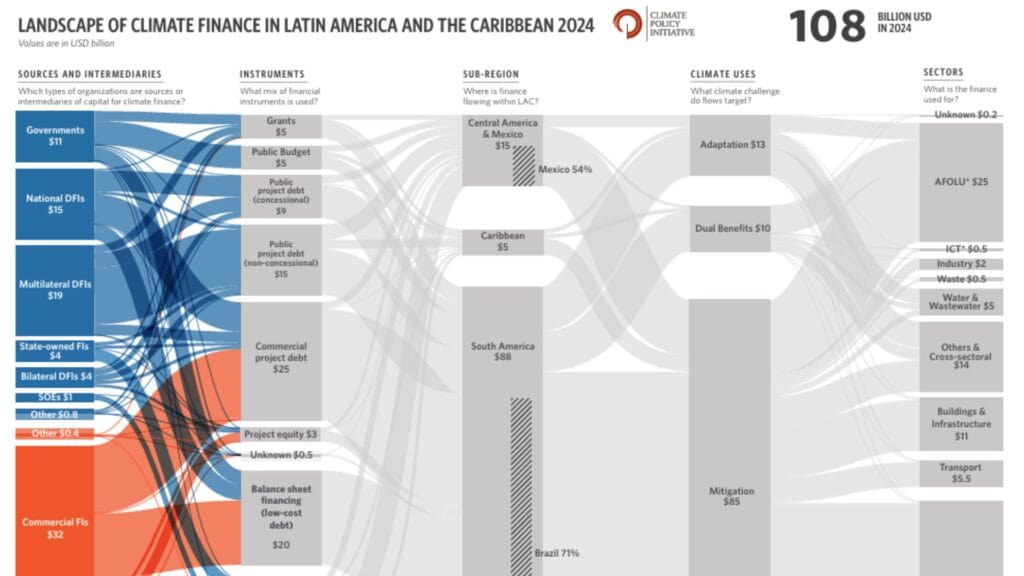
- Climate finance across Latin America and the Caribbean reached $108 billion in 2024, doubling from $54 billion in 2020.
- Fossil fuel investment still reached $95 billion, more than twice the $43 billion in climate finance directed to energy systems.
- Adaptation attracted just 11% of tracked climate finance, while major funding gaps persist across transport, industry and land use.
Climate finance across Latin America and the Caribbean has doubled in four years, but capital is still falling short of the region’s transition needs.
New research from Climate Policy Initiative (CPI) found climate finance reached $108 billion in 2024, up from $54 billion in 2020. The growth comes as renewables already provide close to 60% of regional electricity, more than twice the global average.
Yet the broader capital picture remains heavily exposed to fossil fuels. Around $95 billion flowed into fossil fuels in 2024. By comparison, climate finance for energy systems totaled $43 billion.
The figures suggest that closing the transition gap will require more than mobilizing new money. Governments and financial institutions will also need to redirect existing capital toward low-carbon and climate-resilient investment.
“Climate finance in Latin America and the Caribbean (LAC) has doubled. The key question now is whether finance is reaching the investments that can drive the region’s climate transition while delivering broader economic and development benefits,” said Barbara Buchner, Chief Executive Officer, Climate Policy Initiative. “The region has significant pools of domestic capital, growing private-sector interest, and major investment opportunities across energy, transport, agriculture, and nature. The priority now is to mobilize funding at scale, by reducing barriers to investment and better connecting available finance with bankable opportunities.”

Critical sectors remain short of capital
Despite the four-year increase, climate finance was broadly flat against 2023, when flows reached about $110 billion.
Some of the largest gaps sit in sectors central to decarbonization. Industry receives roughly 26 times less climate finance than estimated mitigation needs through 2030. Transport receives around 25 times less.
Agriculture, forestry and other land use receives more than seven times less than estimated regional needs. Excluding Brazil, that gap rises to 125 times. This is particularly significant because the sector accounts for 54% of LAC greenhouse gas emissions.
The economic case for closing these gaps extends beyond emissions. CPI estimates the climate transition could generate more than $15 trillion in economic co-benefits through 2050. That equates to roughly $577 billion annually, more than five times the climate finance tracked in 2024.
Fossil fuels compete for investment
The region starts with a comparatively clean electricity system. Renewables account for around 60% of its power mix, with hydropower supplying about half of clean generation.
However, hydropower dependence also exposes electricity systems to drought and climate variability. That raises the investment case for diversified renewables, grids, storage and resilience.
Fossil fuels remain a major competitor for capital. The $95 billion invested in fossil fuels during 2024 was more than double climate finance for energy systems.
Redirecting part of those financial flows could therefore complement efforts to raise new transition capital. The region also has opportunities across critical minerals, forests, biodiversity and other natural assets.
RELATED ARTICLE: Salesforce Unveils Sustainable AI Policy Principles and Climate-Focused Initiatives
Domestic finance provides a foundation
Local capital already plays a substantial role. Domestic sources supplied around 69% of tracked climate finance in 2023 and 2024.
Brazil accounted for 58% of LAC climate finance in 2024, with domestic actors providing around 90% of its total. Climate finance in Brazil has grown at a 28% compound annual rate since 2020, driven largely by solar installations and climate-aligned agriculture.
Mexico receives around 64% of its climate finance domestically. Central America has also increased its domestic share, from roughly 10% in 2021 and 2022 to 34% in 2023 and 2024.
Private capital, however, remains concentrated in mature markets. Outside Brazil, Mexico and Chile, public actors provided between 60% and 84% of climate finance in 2023 and 2024.
Adaptation trails mitigation
Adaptation remains one of the clearest financing weaknesses. It accounted for only 11% of tracked climate finance in 2023 and 2024, reaching $12.5 billion last year.
Mitigation finance reached $85 billion in 2024 and has more than doubled since 2020. Adaptation finance increased by 56% over the same period.
That imbalance leaves infrastructure, agriculture, energy systems and businesses increasingly exposed to physical climate risks.
CPI points to high capital costs, political and macroeconomic volatility, fragmented regulation and weak project pipelines as persistent barriers. It calls for stronger investment roadmaps, guarantees, local-currency solutions, project aggregation and climate-risk integration.
For investors and executives, the central issue is increasingly capital allocation. LAC already has substantial domestic finance, deep renewable resources and growing sustainable finance markets. Turning those advantages into investable projects will determine whether the region can convert rising climate finance into a broader economic transition.

The ESG News Editorial Team is comprised of veteran financial journalists and sustainability analysts dedicated to providing real-time, objective reporting on global ESG regulations, climate finance, and corporate governance. Our desk monitors daily developments from the SEC, IFRS, CSRD and international regulatory bodies to ensure our 1M+ readers receive accurate, data-driven insights into the evolving sustainable investment landscape. Follow the ESG News Editorial Team for expert reporting on global sustainability standards, ESG disclosures, and climate policy. Access over 10,000 investigative reports and real-time updates.


