
What China’s 15th Five-Year Plan Means for Global ESG Investors and Capital Markets
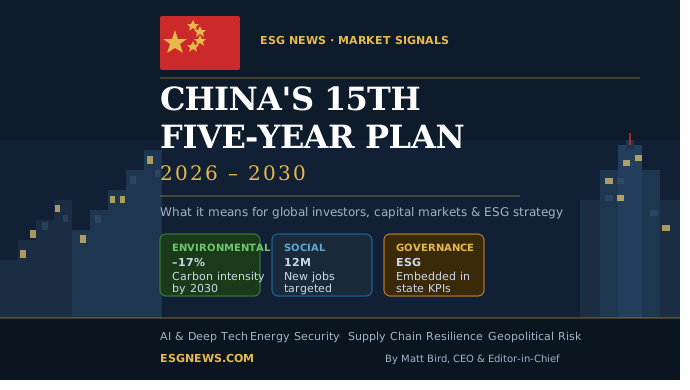
ESG News · Market Signals
The question for global investors isn’t whether China is decoupling — it’s how fast, and which sectors feel it first. Beijing’s new five-year roadmap makes the answer clearer than ever.
By Matt Bird, CEO & Editor-in-Chief, ESG News · Reviewed by the ESG News Editorial Team · May 2026
For multinational corporations, institutional investors, and policymakers tracking long-cycle risk, China’s newly approved 15th Five-Year Plan (2026–2030) is the clearest policy signal in years. It marks a decisive shift away from growth-at-all-costs economics and toward a model built around technological supremacy, supply-chain sovereignty, and systemic risk control — with direct implications for where capital flows, where competition intensifies, and where geopolitical friction accelerates.
Approved during China’s annual “Two Sessions” political meetings in March 2026, the plan arrives during a period of compounding pressure: slowing economic growth, persistent real estate instability, local government debt overhangs, supply-chain fragmentation, and escalating global tensions. The policy response is not stimulus — it is structural repositioning.
|
>7%
Annual R&D spending growth target
|
4.5–5%
Official GDP growth range — lower than prior cycles
|
16–20%
Domestic energy production capacity expansion
|
AI and Deep Tech: Where Beijing Is Placing Its Bets
The single clearest market signal in the 15th FYP is China’s commitment to outcompete the West in foundational technologies — not in five to ten years, but now. The CCP is targeting annual R&D spending growth above 7% while lowering official GDP growth expectations to 4.5–5%, a deliberate trade-off that signals long-term technological competitiveness is being prioritized over near-term economic output.
The government is accelerating investment and policy support across:
- Artificial intelligence and multimodal intelligence systems
- Quantum computing
- Biotechnology
- New energy systems
- Advanced manufacturing
For investors, this has direct implications for competitive dynamics in semiconductors, AI infrastructure, robotics, and clean energy supply chains — sectors where Chinese state-backed players are being systematically resourced to close — or widen — existing gaps with Western peers.
Beijing openly acknowledges its semiconductor vulnerabilities. That acknowledgment is itself a market signal: expect sustained, state-backed investment to close those gaps regardless of external pressure.
To address identified weaknesses in its technology ecosystem, Beijing plans to build new research-focused universities, expand AI-focused educational programs, and create high-tech immigration pathways for global talent. For global tech and chip companies, this trajectory should be read as a long-duration competitive threat, not a cyclical one.
Risk Architecture as Industrial Policy
One of the most significant — and underreported — elements of the 15th FYP is the extraordinary expansion of state-level risk monitoring and early-warning infrastructure. Unlike previous plans focused primarily on growth management, this one dedicates substantial architecture to identifying and mitigating economic, environmental, societal, and national security risks in real time.
Monitoring systems are being expanded across real estate markets, local government debt, cross-border capital flows, strategic mineral supply chains, employment trends, disease outbreaks, carbon emissions, overseas investments, and AI lifecycle risks.
For global capital markets, the practical implication is this: Beijing is building the institutional capacity to move faster on policy intervention — which compresses the window between risk emergence and government response. That changes how investors should model policy risk in China-exposed portfolios.
ESG in the 15th FYP: A Distinct Model Worth Watching
The 15th Five-Year Plan contains substantial ESG-relevant commitments — but delivers them in a form that looks fundamentally different from the voluntary disclosure frameworks that dominate Western ESG practice. Rather than asking corporations to self-report against third-party standards, Beijing is mandating ESG integration top-down through industrial policy, performance metrics, and state capital allocation. For ESG-focused investors, that distinction matters.
|
Environmental
Carbon intensity down 17% by 2030
New dual-control framework, National Low-Carbon Transition Fund, 100GW offshore wind, 110GW nuclear. Green transformation embedded across Chapter VIII. |
Social
12M jobs, ethnic minority protections, disability inclusion
Employment stabilization, Ethnic Unity and Progress Law, expanded social welfare systems, and healthcare access improvements across underserved regions. |
Governance
ESG metrics baked into state performance
Climate targets embedded in local government KPIs. New National Development Planning Law institutionalizes long-term policy transparency for investors. |
Environmental Chapter VIII — titled “Accelerate the comprehensive green transformation of economic and social development” — reads essentially as an ESG environmental chapter at the sovereign level. The plan targets a 17% reduction in carbon dioxide emissions per unit of GDP by 2030 and introduces a critical policy shift: moving from controlling energy consumption to controlling carbon emission intensity and total carbon volume. A new National Low-Carbon Transition Fund is designed to mobilize green investment at scale. Offshore wind is targeted at 100GW and nuclear at 110GW by 2030.
The plan does not set an absolute emissions cap — leaving meaningful ambiguity about how China will convert record renewable deployment into sustained emissions reductions. Critics note this represents a continuation of intensity-based targets rather than the hard emissions ceilings that institutional ESG frameworks increasingly require.
Social The social pillar is present but thinner than the environmental commitments. Employment stabilization targets — 12 million new jobs and unemployment held near 5.5% — represent the core social floor. The plan passed an Ethnic Unity and Progress Promotion Law protecting ethnic minority languages and cultural heritage, and expands social welfare systems, healthcare access, and disability inclusion initiatives.
Governance Rather than relying on corporate disclosure to surface ESG data, Beijing is embedding climate and sustainability metrics directly into local government performance indicators and state-owned enterprise mandates. The newly passed National Development Planning Law delivers greater policy transparency and predictability for foreign investors. Full-lifecycle AI risk management systems are also being developed — a governance-layer innovation with no direct Western equivalent at state scale.
China is not adopting Western ESG frameworks — it is building its own. The question for global investors is whether state-mandated ESG integration produces comparable outcomes, or simply comparable language.
For ESG-focused institutional investors, the 15th FYP presents a genuine analytical challenge. The environmental ambition is real and the capital commitments are substantial. But the absence of absolute emissions caps, the opacity of social governance metrics, and the fusion of ESG with national security objectives mean that standard ESG scoring frameworks — built around voluntary corporate disclosure — will systematically struggle to price China-linked exposure accurately.
RELATED ARTICLE: Air China Details Climate Strategy And Governance Framework in 2025 ESG Report
Energy and Resource Security: Reading the Supply Chain Signal
The plan targets a 16–20% expansion of domestic energy production capacity by 2030, driven primarily by renewables. Grain production capacity is targeted at approximately 725 million tonnes. Strategic oil and gas reserves are being expanded alongside the Power of Siberia 2 pipeline project with Russia. Taken together, these moves signal that China is actively building redundancy into every critical input — energy, food, minerals — to reduce exposure to external supply disruption.
Lower future domestic oil production targets may signal that Beijing expects EV adoption to suppress oil demand growth faster than previously modeled — a data point with meaningful implications for global energy markets and long-term fossil fuel demand curves.
Consumption Growth: Don’t Overread the Headline
Chinese officials continue signaling domestic consumption growth, and the 15th FYP references “vigorously boosting consumption.” Investors should read this carefully. The plan does not represent a structural rebalancing toward a consumer-driven economy. Consumption language in the plan is largely oriented toward domestic resilience and reduced external vulnerability — not the kind of demand-side liberalization that Western consumer brands have historically waited for.
The Portfolio-Level Takeaway
China’s 15th Five-Year Plan signals a country actively restructuring its economy around strategic resilience and reduced external dependency. For global investors and multinationals, the compounding effects are significant: accelerating competition across advanced technologies, critical minerals, AI infrastructure, and renewable energy; tightening supply-chain access in sectors Beijing deems strategic; and a policy environment increasingly optimized for national security objectives alongside economic ones.
On ESG specifically, the plan demands a more sophisticated analytical lens. The environmental commitments are substantive and state-backed at a scale few governments can match — but they arrive without absolute emissions accountability. The governance architecture is genuinely innovative — but it serves party objectives first. Standard ESG scoring tools were not built to evaluate sovereign-scale, top-down ESG integration of this kind. Investors who rely on them without adjustment are likely mispricing both the opportunity and the risk.
The CCP still faces significant execution headwinds — local government paralysis, demographic pressure, debt burdens, and slowing productivity growth are structural constraints that monitoring systems alone cannot resolve. But the direction of travel is unambiguous. The 15th Five-Year Plan is Beijing’s clearest statement yet of what it is building toward — and what it intends to win.
Executive Editor
Matt Bird is the CEO and Editor-in-Chief of ESG News, the leading independent media platform covering environmental, social, and governance developments for corporate sustainability professionals, investors, and policymakers. With over a decade at the intersection of sustainability, finance, and media, Matt leads a global editorial team that has published more than 10,000 articles on ESG, climate policy, and sustainable business. Matt Bird ESG News Profile | Matt Bird LinkedIn Profile

The ESG News Editorial Team is comprised of veteran financial journalists and sustainability analysts dedicated to providing real-time, objective reporting on global ESG regulations, climate finance, and corporate governance. Our desk monitors daily developments from the SEC, IFRS, CSRD and international regulatory bodies to ensure our 1M+ readers receive accurate, data-driven insights into the evolving sustainable investment landscape. Follow the ESG News Editorial Team for expert reporting on global sustainability standards, ESG disclosures, and climate policy. Access over 10,000 investigative reports and real-time updates.