
TotalEnergies Cuts Methane Emissions 65%, Exceeds 2025 Climate Targets In New Progress Report
- Methane emissions reduced 65% since 2020, surpassing the company’s 60% target and advancing toward an 80% cut by 2030
- Scope 1 and 2 emissions fall to 33.1 Mt in 2025, beating the 37 Mt target and down from 46 Mt in 2015
- Integrated power expansion reaches 48 TWh, helping drive an 18.6% drop in lifecycle carbon intensity, ahead of target
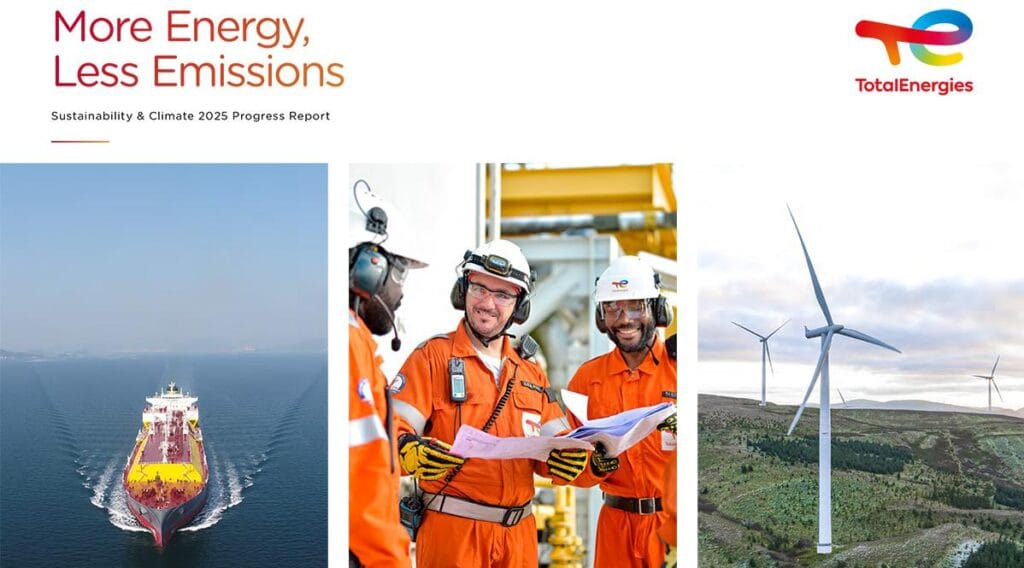
TotalEnergies has reported stronger than expected emissions reductions and accelerated growth in low carbon power, as it publishes its Sustainability and Climate 2026 Progress Report, offering a detailed snapshot of how its transition strategy is translating into measurable outcomes.
The report outlines progress against the company’s 2025 targets and will form part of its broader regulatory disclosures under the Corporate Sustainability Reporting Directive. It arrives at a time when European energy majors face mounting scrutiny over the pace and credibility of their transition strategies.
Oil And Gas Operations Deliver Faster Emissions Cuts
Within its oil and gas division, TotalEnergies continues to focus on lower emissions production while maintaining output competitiveness. The company reports that operated methane emissions have been reduced by 65% since 2020, exceeding its initial 60% reduction goal ahead of schedule.
Scope 1 and 2 emissions from operated assets totaled 33.1 million tonnes in 2025, a significant decline from 46 million tonnes in 2015. This places the company well ahead of its stated target of 37 million tonnes for the year.
Greenhouse gas emissions across operated oil and gas facilities have now dropped 38% compared to 2015 levels. At the project level, new developments in Brazil and the United States have contributed to further improvements in emissions intensity, which now stands below 16 kg CO₂e per barrel of oil equivalent. This sets a new internal benchmark for future projects.
The company positions these gains as evidence that upstream production can be optimized for both cost and carbon efficiency, a key argument in ongoing debates over the role of hydrocarbons in transition pathways.
Integrated Power Expands Role In Energy Mix
TotalEnergies’ second growth pillar, integrated power, is scaling rapidly. Net electricity production reached 48 terawatt-hours in 2025, equivalent to roughly 10% of the company’s hydrocarbon output.
This expansion is directly influencing the company’s overall emissions profile. Lifecycle carbon intensity across energy products sold has fallen by 18.6% compared to 2015 levels, exceeding the company’s 17% reduction target.
The company attributes this progress to its multi-energy model, which combines traditional oil and gas operations with growing investments in renewables and electricity generation. The model is designed to balance energy security, profitability, and emissions reduction, a combination that remains central to investor expectations.
RELATED ARTICLE: TotalEnergies to Lead France’s Largest Renewable Energy Project
Governance And Disclosure Under CSRD
The report also reflects evolving governance requirements under European regulation. By aligning its disclosures with the Corporate Sustainability Reporting Directive, TotalEnergies is preparing for more stringent transparency and comparability standards across ESG reporting.
This shift carries implications for capital allocation and investor scrutiny. Detailed emissions metrics, project-level performance, and lifecycle intensity measures are becoming essential tools for evaluating transition credibility.
Aurélien Hamelle, President Strategy and Sustainability, will present the findings and take questions in a public webcast, reinforcing the company’s effort to position its transition narrative within a more accountable, regulated framework.
What It Means For Executives And Investors
For C-suite leaders and investors, the report offers a clear signal that large scale emissions reductions are achievable within existing energy systems when operational efficiency and capital discipline align.
TotalEnergies’ ability to exceed its interim targets strengthens its position in a competitive field of European energy majors navigating investor pressure, policy constraints, and volatile energy demand.
At the same time, the company’s continued investment in oil and gas alongside renewables reflects a broader industry reality. Transition strategies are not linear. They require balancing near-term supply needs with long-term decarbonization commitments.
A Test Case For The Multi Energy Model
TotalEnergies’ latest results provide a real-world test of the multi-energy model increasingly adopted across the sector. The combination of declining operational emissions and growing low-carbon power output suggests a pathway that does not rely on rapid divestment from hydrocarbons.
The global significance extends beyond one company. As regulators tighten disclosure rules and investors demand clearer transition metrics, performance data like this will shape capital flows, policy debates, and the credibility of corporate climate strategies.
For now, TotalEnergies has moved ahead of its own targets. The next phase will test whether that momentum can be sustained as 2030 goals approach and scrutiny intensifies.
Follow ESG News on LinkedIn

The ESG News Editorial Team is comprised of veteran financial journalists and sustainability analysts dedicated to providing real-time, objective reporting on global ESG regulations, climate finance, and corporate governance. Our desk monitors daily developments from the SEC, IFRS, CSRD and international regulatory bodies to ensure our 1M+ readers receive accurate, data-driven insights into the evolving sustainable investment landscape. Follow the ESG News Editorial Team for expert reporting on global sustainability standards, ESG disclosures, and climate policy. Access over 10,000 investigative reports and real-time updates.