

ESG News Week In Review: 16 September – 30 September
Washington repealed its power plant carbon rules, Brussels handed heavy industry 121 million free permits, and Italy’s sovereign green bond still ran 13 times covered. Retreat on the rules has not yet meant retreat on the capital.
The repeal landed on 16 September. The EPA struck most of the 2024 federal greenhouse gas standards for coal and gas power plants, proposed removing what remained, and moved to rescind its 2015 greenhouse gas findings for fossil fuel generation, claiming $310 billion in savings for the power sector. What was a reported threat a fortnight earlier is now the baseline against which every US utility transition plan is written.
Europe spent the same fortnight converting climate ambition into competitiveness policy. Member states approved 121 million additional free CO2 permits for heavy industry between 2026 and 2030, worth about $9.52 billion in avoided carbon costs, then agreed to hold surplus allowances until 2030 to damp price spikes. Parliament widened CBAM to downstream steel and aluminium products while backing a temporary decarbonisation fund for 2027 to 2029. Emmanuel Macron and more than a dozen governments pressed to delay methane import rules by a year.
Capital markets did not take the hint. Italy raised roughly $9.4 billion through a 12-year sovereign green bond that drew an order book above $129 billion, covered more than 13 times, with ESG investors taking around 80% of the allocation. Hong Kong lined up as much as $2.6 billion of digital green bonds across four currencies, the World Bank Group backed $2.86 billion for Brazilian industrial decarbonisation, and the UK put $3.3 billion behind commercial fusion. Investor demand is not the scarce input; eligible assets and deliverable projects are.
The story to carry into next week is the methane import rules. The European Commission is weighing a move from January 2027 to January 2028, with non-compliance fines reaching 20% of annual turnover and intensity limits due from 2030. Industry-backed research says nearly half of EU gas imports could struggle to comply, which makes this the clearest test yet of whether energy security now outranks the bloc’s own climate timetable.
- 82Stories published, 16 to 30 September
- $310bnSavings the EPA claims from repealing power plant carbon rules
- 121mExtra free CO2 permits for EU heavy industry through 2030
- $129bnOrder book for Italy’s $9.4 billion sovereign green bond
- 2,500Electric Class 8 trucks in the largest US order to date
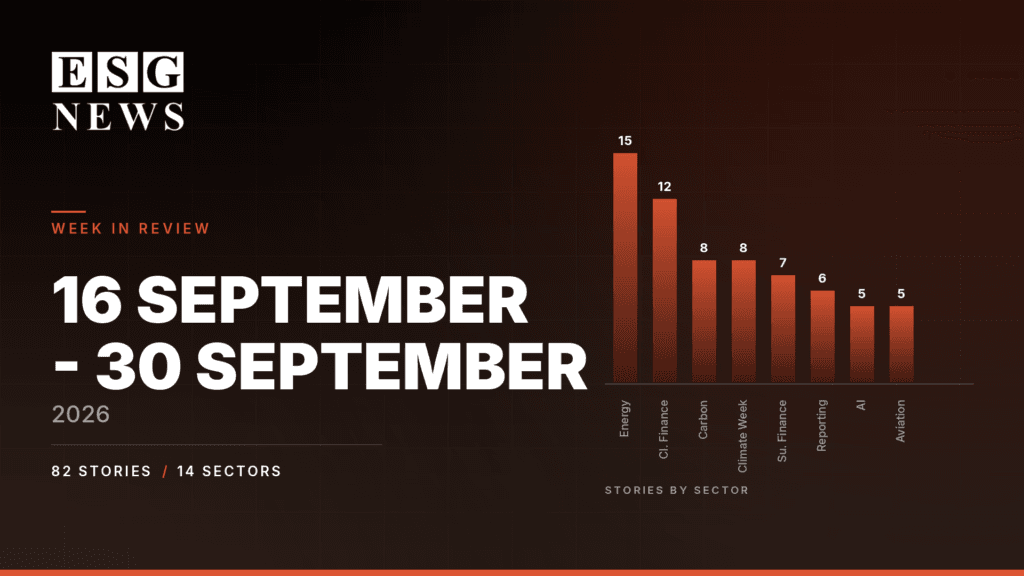
Energy
15- UK, US Link AI Supercomputers for Fusion ResearchUKAEA and Princeton will federate two fusion supercomputers, the $60.6 million SUNRISE and $13 million STELLAR-AI, to share data and train models.
- Masdar, Taaleri Open 154MW Serbia Wind FarmCibuk 2 lifts the complex to 312 MW, the largest wind hub in the Western Balkans, representing over $590 million of inward investment.
- Google Backs Near-Zero Emissions Steel PlantGoogle will take environmental attributes on up to 91,000 tonnes of Stegra steel, whose hydrogen route cuts emissions by as much as 95%.
- GE Vernova Wins 29.4 MW Japan Wind OrderEurus Energy picked seven turbines for an Aomori project, as Japan targets renewables at 36% to 38% of electricity by 2030.
- Google Backs Stegra Green Steel Through EAC DealFollow-up detail on the Stegra agreement: book-and-claim certificates give the producer early cash flow without Google taking physical delivery.
- Moeve Starts $1.2 Billion Green Hydrogen ProjectConstruction begins on a 300 MW Huelva facility producing about 45,000 tonnes annually, with roughly $357 million of Spanish government support.
- Hilton Launches Zero Emission Hotel PrototypeAll-electric Home2 Suites design targets 30% better efficiency and could cut 440 tonnes of operational carbon per hotel across 13 modelled cities.
- French President Urges EU to Delay Methane Import RulesMacron wants methane import requirements pushed to January 2028, joining more than a dozen member states seeking delay or suspension.
- China Clean Tech Exports Avoid 374 Million Tons of CO2Exports worth $194 billion avoided 374 million tonnes in 2025, more than UK annual emissions, with lifetime avoidance up 31%.
- Amazon Energy Projects Add $11 Billion to US GDPOxford Economics attributes nearly $11 billion of GDP and 22,000 annual jobs to Amazon’s carbon-free energy projects between 2023 and 2025.
- Germany Sets 2045 Deadline to Phase Out Fossil FuelsBerlin commits explicitly to leaving fossil fuels by 2045, with renewables targeted at a minimum 80% of electricity consumption by 2030.
- Microsoft, PepsiCo Back Record 2,500-Truck Tesla Semi OrderZET SCALE ordered 2,500 battery-electric Class 8 trucks, the largest US order to date, with pooled demand targeting at least 10,000.
- EU Weighs Delay to Methane Import Rules as Energy Security Risks RiseCommission considers moving reporting rules to January 2028, with non-compliance fines up to 20% of turnover and intensity limits from 2030.
- Moeve, Emerita Bring Renewable Diesel to Spanish Mining in Industry FirstSpain’s first industrial-scale mining deployment of renewable diesel should cut about 2,600 tonnes yearly at the Iberian Belt West project.
- Shell Backs Major LNG Canada Expansion as Asian Gas Demand RisesPhase 2 doubles capacity to 28 million tonnes a year for the early 2030s, with Shell forecasting LNG demand up 65% by 2050.
Climate Finance
12- BII Backs BlueOrchard Climate Fund’s $250M First CloseBlended structure reached a $250 million first close anchored by British International Investment and FinDev Canada, built to meet Solvency UK criteria.
- World Bank Backs $2.86B Brazil Industry DecarbonizationA $2.86 billion package targets steel, cement, chemicals and aluminium as Brazil aims to cut industrial emissions intensity 30% by 2033.
- Brookfield Invests $600 Million in ACME Green FuelsUp to $600 million into ACME Cleantech gives Brookfield first exposure to green ammonia and methanol projects in India and Oman.
- Pulse Fund Raises $63M for Early Stage Climate TechDebut fund closed at $63 million across energy, infrastructure, food and mobility, backed by the Pritzker family and an Asian sovereign fund.
- Standard Chartered Backs Thailand’s $795M Biodiversity SLBAsia’s first sovereign bond with biodiversity targets raised $795 million at 1.45 times cover, aiming to cut net emissions 47% by 2035.
- CPI Research Finds Latin America Climate Finance DoubledRegional climate finance doubled to $108 billion in 2024, but fossil fuel investment reached $95 billion and adaptation took only 11%.
- UK Pledges $438 Million for Climate Security RisksBritain commits $438 million, mostly to the Global Environment Facility, and wants climate risk written into national security and defence planning.
- ESB Raises $575 Million in Ireland’s First European Green Bond DealFirst Irish corporate issue under the EU framework raised about $575 million at a 4.375% coupon for networks, renewables and storage.
- Reverion Raises $175 Million to Scale Dispatchable Clean Power TechnologySeries B funds a tenfold capacity increase to 250 MW for reversible solid-oxide systems claiming 74.2% electrical efficiency in generation mode.
- UK Commits $3.3 Billion to Build Commercial Fusion Energy IndustryMore than $3.3 billion over five years anchors the Nottinghamshire STEP plant, though commercial fusion electricity remains undemonstrated anywhere.
- Italy’s Green Bond Sees Demand Top $129 Billion in Global OrdersA $9.4 billion 12-year sovereign green bond drew orders above $129 billion, covered more than 13 times, with ESG investors taking 80%.
- EIB, BNP Paribas Back $794 Million Guarantee Plan for EU Power GridsGuarantee portfolio of up to $794 million for grid component makers could unlock $3.18 billion of investment under the Pan-EU Power Grid package.
Carbon Markets
8- EU Parliament Backs Expanded CBAM and Decarbonisation FundParliament extended the border levy to downstream steel and aluminium goods, tightened anti-circumvention rules and backed a 2027 to 2029 decarbonisation fund.
- EU Backs More Free CO2 Permits for Heavy IndustryMember states approved 121 million extra free permits to 2030, worth about $9.52 billion in avoided carbon costs for heavy industry.
- EU’s First Full Scale CO2 Storage Starts FridayINEOS Greensand begins storing up to 400,000 tonnes yearly beneath the Danish North Sea, with design capacity of 4 to 8 million.
- Mombak Targets $150 Million for Amazon ReforestationSecond fund seeks $150 million with a $38.88 million Brazilian credit line, adding Salesforce to buyers including Google and Microsoft.
- EU Backs Carbon Market Changes to Curb Price SpikesGovernments will hold surplus permits until 2030 to buffer price spikes, after pressure from Poland and Italy over industrial energy costs.
- ADM Plans 800,000-Ton Carbon Removal Credit Offering from Nebraska CCSMore than 800,000 tonnes of annual capacity certified by Puro.earth, with first issuance expected by year-end and a 15-year crediting period.
- Canada Develops Article 6 Framework to Expand International Carbon MarketsOttawa is designing rules for trading internationally transferred mitigation outcomes, aiming to attract private capital into removal and nature-based projects.
- Salesforce Backed Deal Brings Cowboy Clean Fuels Into Carbon Removal MarketFirst durable removal sale, arranged via Milkywire for 2026 delivery, pairs permanent storage with renewable natural gas in Wyoming.
Climate Week NYC
8- Climate Week Report: Renewable Gaps Threaten Clean Energy GoalsRE100 members now source 59% renewable electricity, with South Korea, Singapore and Taiwan showing the widest procurement gaps and Nike reaching 100%.
- Global Leaders Push to Triple Renewables by 2030Leaders backed tripling renewable capacity by 2030, with COP31 pursuing 35% electrification by 2035 and 90% of surveyed firms expecting electrification.
- Iceland PM Puts Geothermal at Heart of Energy ResilienceGeothermal supplies over 90% of Icelandic heating, and the government is preparing IDDP-3, a superhot well at Hengill promising far greater output.
- Day 1 at Climate Week NYC: Leaders Shift Focus to DeliveryNigeria launched a $300 million clean energy fund as grid capacity emerged as the central constraint across data centres and transport.
- Day 2 at Climate Week NYC: Energy Transition Enters Delivery EraDiscussion moved to procurement and traceability for steel, cement and food, with pressure on institutions to convert targets into delivery.
- Behind the Crown: How Rolex Turned Quiet Values Into Its Strongest StatementFeature on Rolex marking 50 years of its Awards and a record museum gift, arguing its values show through those it supports.
- Day 3 at Climate Week NYC: AI, Energy and Climate DeliveryCalifornia pursued a carbon market link with Washington as the Under2 Coalition widened cooperation and AI electricity demand entered the debate.
- Day 4 at Climate Week NYC: Governments and Business Focus on Climate DeliveryGovernors and ministers focused on electrification and clean industry, with the Empire State Building used as a live retrofit case study.
Sustainable Finance
7- LOIM Expands Net Zero Funds to US and JapanNew US and Japan climate-aligned equity strategies take the TargetNetZero platform past $6.8 billion across 11 pooled funds and mandates.
- Navitas Solar Plans $1 Billion Clean Energy ExpansionA $1.04 billion five-year plan adds cells, wafers and storage, with a 2.4 GW Gujarat cell plant phase due by July 2027.
- J.P. Morgan, Paraguay Launch $200 Million Sustainable Forestry InvestmentA $200 million platform combining commercial forestry, restoration and carbon credits expects capital deployment from early 2027, with timber processed locally.
- Hong Kong Plans $2.6 Billion Digital Green Bond in World’s Largest SaleUp to $2.6 billion across four currencies would be the largest digital bond sale, as the city makes such issuance routine.
- BII Commits $65 Million to Expand Sustainable Finance in Zambia and ZimbabweA $15 million anchor supports Zanaco’s debut $100 million sustainability bond programme, with $50 million more for Zimbabwean agriculture finance.
- Crédit Agricole Launches Natural Capital Division With $227M Forest FundNew natural capital arm starts with forests, a planned EcoTree majority stake and an Amundi fund targeting about $227 million.
- ESMA Sets 2027 Agenda to Simplify and Integrate EU Capital MarketsSupervision will expand across ESG ratings, European Green Bonds and benchmarks, alongside T+1 settlement and the European Single Access Point.
ESG Reporting
6- Climate Pledge Firms Cut Operational Emissions 11%Over 700 signatories worth $3.8 trillion in revenue cut operational emissions 11% against 7% elsewhere, but direct emissions fell only 4%.
- ASIC Finds Climate Reporting Improving Under New RulesAustralia’s regulator found better governance across 40 reports but persistent gaps in forward-looking disclosure, and will widen its review in 2026-27.
- The era of unsubstantiated sustainability claims is over as European rules tightenGuest post argues the Empowering Consumers Directive forces retailers toward technical proof and cross-functional governance as trust in green claims falls.
- ERM, osapiens Partner to Turn ESG Compliance Data Into Business ActionPartnership pairs advisory work with an AI platform covering CSRD, CBAM, CSDDD and deforestation rules, pushing compliance data into operational decisions.
- Masdar Clean Power Generation Rises 38% as Portfolio Reaches 66.5GWOutput rose 38% to 40.2 TWh in 2025, avoiding 19.5 million tonnes, while a $1 billion green bond drew $6.6 billion of orders.
- GRI to Launch New Sustainability Reporting Standard for Food and Beverage CompaniesFirst dedicated food and beverage sector standard will pilot a faster development process; 43% of listed companies in the sector already use GRI.
AI
5- Google, NASA AI Maps Global Methane EmissionsMAPL-EMIT found about 50% more plausible plumes than human analysis, identifying over 23,000 additional methane sources from open satellite data.
- Oracle Backs 1.7 GW of Texas Wind for AI GrowthTen Texas wind projects totalling more than 1.7 GW could avoid 1.8 million tonnes annually while feeding Oracle’s AI growth on ERCOT.
- EU Proposes Energy and Water Labels for Data CentresSites above 500 kW would disclose energy and water efficiency as EU data centre capacity heads toward 28 GW by 2030.
- Victoria Sets Green Power Rules for New Data CentresProposed rules would force new sites to secure their own renewable power and storage and pay for grid connections and upgrades.
- Sphera Adds AI Tools to Turn ESG Data Into Business ValueNew tools target fragmented corporate, supplier and product carbon data, arguing programmes tied to business value survive shifting disclosure requirements.
Aviation
5- Sasol, White Desert Launch South Africa SAF DealFirst commercial volumes will fuel Cape Town to Antarctica flights, with Natref’s certification positioning Sasol for later hydrogen-based e-fuels.
- FedEx Expands SAF Deals Across Five U.S. AirportsMore than 20 million gallons of neat fuel through 2027 at 30% to 50% blends, against a 30% target by 2030.
- Japan Airlines Signs First CORSIA Carbon Removal DealDescribed as the first removal purchase built for CORSIA, the Climeworks portfolio spans soil carbon, biochar and direct air capture.
- Explainer: Navigating the 45Z Clean Fuel Production CreditExplainer on the Section 45Z production credit, which rewards fuel producers on measured carbon intensity rather than prescribed technology choices.
- Germany, Austria and Luxembourg Launch $2.5 Billion e-SAF SchemeJoint $2.5 billion double-auction mechanism narrows the price gap for synthetic fuels, with about 50 EU projects awaiting investment decisions.
Climate
4- Trump EPA Repeals Power Plant Carbon RulesEPA repealed most 2024 standards and proposed removing the rest, claiming $310 billion of savings while moving to rescind its 2015 findings.
- Google, Terradot Target 2M Tons of Climate ImpactGoogle buys one million tonnes of methane elimination by 2030 and one million of permanent removal by 2040 across Brazilian rice farms.
- Mars Reaches 98% Responsible Cocoa SourcingSuppliers delivered volumes equal to 98% of 2025 cocoa, deforestation-free after cut-off dates, with monitoring covering all participating West African farmers.
- Schroders, CalPERS Map $1.3 Trillion Adaptation MarketAdaptation demand could reach $1.3 trillion annually by 2030; the framework scores 102 activities, with the median avoiding $3.10 per dollar spent.
ESG Tools & Services
4- Verra Launches Standard for Scope 3 Climate ActionEach Scope 3 Unit represents a tonne reduced inside a value chain, with first methodologies covering agriculture and low-carbon concrete.
- ISO, UNDP Launch First Global Standard to Embed SDGs in BusinessISO/UNDP 53001 is the first management system standard for integrating the Sustainable Development Goals into strategy, objectives and performance measurement.
- CSRWorks Expands EcoVadis Advisory Support Across Global MarketsAdvisory firm reports more than 500 EcoVadis assessments supported, with around 60% of clients reaching Platinum or Gold medal ratings.
- Schneider Electric Expands SME Decarbonization Program With GreenlyGlobal expansion gives partners over $34,000 of annual programme value, after early audits found one manufacturer could save $178,000 yearly.
Circular Economy
4- LEGO Owners Plan $1.6 Billion Climate Investment PushKIRKBI Climate will add $1.6 billion over five years, doubling its portfolio, with circular plastics central as EU packaging rules bite.
- Levi Strauss, M&S Launch Fashion Renewable CollaborativeInitiative helps apparel suppliers access power agreements, certificates and on-site solar, targeting the textile processing that drives over half of fashion emissions.
- Meta Backs MacroCycle rPET Plant With Multiyear Procurement DealMultiyear certificate purchase underwrites a first commercial US plant producing 5,000 tonnes of recycled PET from mixed and contaminated waste.
- Primark Signs Long Term Circ Deal to Scale Textile-to-Textile RecyclingFirst multi-year offtake with a textile-to-textile recycler secures recycled polyester from 2029, targeting the hard problem of polycotton blends.
Sustainability Leaders & Executive Moves
2- MSCI Names Sonia Kim as Head of SustainabilityKim arrives from GHGSat with product experience at S&P Global, Fitch and Moody’s, taking strategy and commercial ownership of MSCI sustainability.
- Barclays Appoints Paul Williams as Global Head of Operational SustainabilityNew role embeds sustainability across procurement, real estate and technology, bringing sustainable procurement expertise into wider bank operations.
Solar
1- Salzgitter, Zelestra Sign Germany’s Largest Hybrid PPASteelmaker contracts 147 MW of solar supplying about 158 GWh yearly, paired with 79 MW of batteries it will control itself.
Environmental
1- Grassroots Carbon Targets 40 Million U.S. Acres by 2030Company aims to improve grazing on 40 million acres, roughly 6% of the US total, with 10 million fully verified.
What to Watch Next Week
Deadlines, rulings and deal clocks that follow from this week.
- Methane import rules, January 2027. The Commission decides whether to push reporting requirements to 2028. Fines reach 20% of annual turnover and intensity limits apply from 2030.
- ADM carbon removals, year-end. First issuance of more than 800,000 tonnes of annual Puro.earth-certified removal capacity is expected once the audit completes.
- CBAM decarbonisation fund, 2027. The temporary fund for EU producers and downstream companies exposed to carbon costs is due to run from 2027 to 2029.
- ESMA supervision, 2027. Oversight expands across ESG ratings, European Green Bonds and benchmarks, alongside T+1 settlement and the European Single Access Point.
- Navitas Solar cells, July 2027. The first phase of the 2.4 GW solar cell facility under development in Gujarat is expected to begin operations.
Get this in your inbox before it reaches the site.
Subscribe to the ESG News newsletter
The ESG News Editorial Team is comprised of veteran financial journalists and sustainability analysts dedicated to providing real-time, objective reporting on global ESG regulations, climate finance, and corporate governance. Our desk monitors daily developments from the SEC, IFRS, CSRD and international regulatory bodies to ensure our 1M+ readers receive accurate, data-driven insights into the evolving sustainable investment landscape. Follow the ESG News Editorial Team for expert reporting on global sustainability standards, ESG disclosures, and climate policy. Access over 10,000 investigative reports and real-time updates.


