Lenovo,VCM And ClimeCo Partner To Scale Sustainable Manufacturing In Saudi Arabia
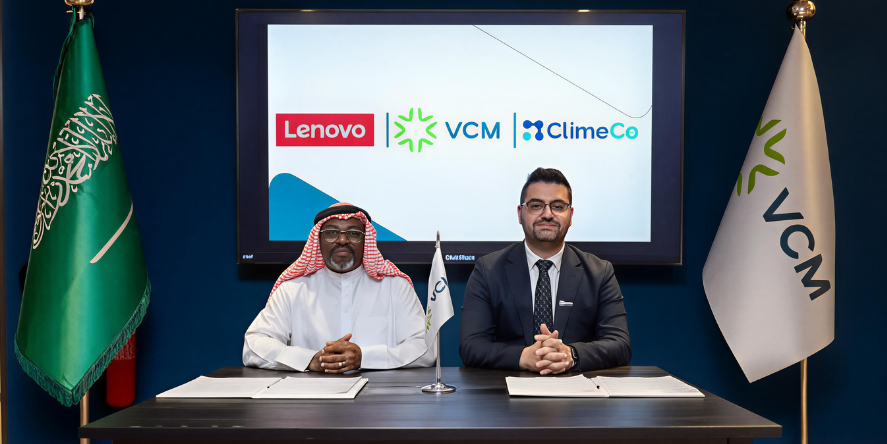
- Lenovo will use a structured emissions management and offset strategy as it expands manufacturing operations in Saudi Arabia.
- VCM will support the carbon credit strategy through market infrastructure and advisory expertise aligned with international standards.
- The partnership is designed to direct carbon finance into Saudi Arabia’s voluntary carbon market ecosystem, supporting local climate projects and industrial growth.
Riyadh is positioning industrial growth and carbon market development as connected priorities, as the Regional Voluntary Carbon Market Company, Lenovo and ClimeCo launch a partnership to support Lenovo’s expanding manufacturing footprint in Saudi Arabia.
The collaboration will provide Lenovo with a structured emissions management and offset strategy as the technology company builds one of its largest global manufacturing operations in the Kingdom. The agreement brings together VCM’s carbon market infrastructure, ClimeCo’s decarbonization capabilities and Lenovo’s manufacturing expansion plans.
For Saudi Arabia, the deal carries significance beyond one company’s factory operations. It links foreign industrial investment with the country’s push to develop a domestic voluntary carbon market, create local environmental value and support broader economic diversification goals.
Carbon Credits To Support Lenovo’s Manufacturing Growth
Under the partnership, Lenovo will address operational emissions through carbon credits. The companies said the approach will help advance verified, high-integrity carbon projects within Saudi Arabia.
VCM will provide market infrastructure and advisory support to structure and facilitate the carbon credit strategy. The company said the work will be aligned with international standards and best practices.
ClimeCo, already a long-standing carbon offset partner to Lenovo, will work with the company to support a transparent and credible approach to industrial sustainability. The goal is to connect manufacturing growth with measurable emissions management, while also creating local economic benefits through carbon finance.
The partnership comes as large industrial companies face growing pressure to align growth strategies with climate accountability. For executives, the issue is no longer only reputational. Carbon exposure now carries implications for procurement, investment, market access and long-term resilience.
VCM Sees Domestic Demand For Saudi Carbon Credits
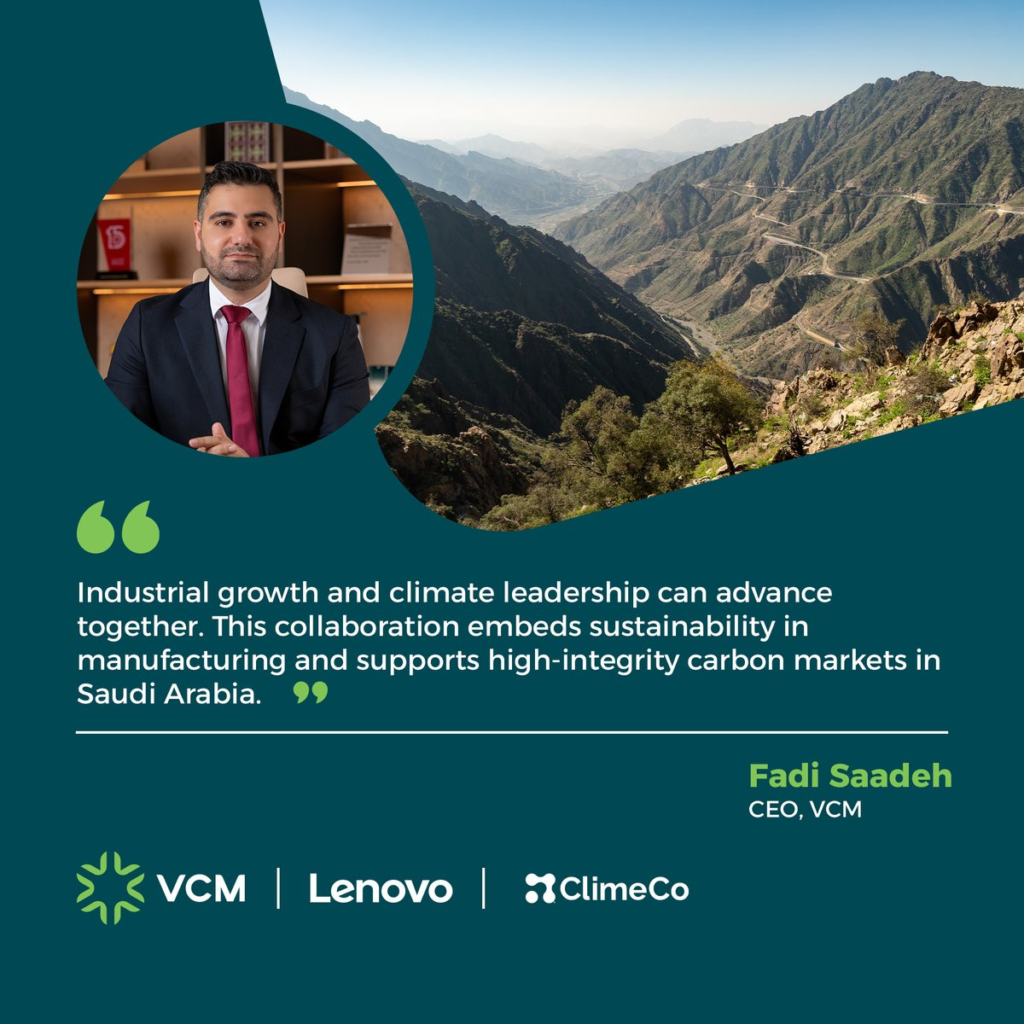
Fadi Saadeh, CEO at VCM, commented, “This partnership demonstrates that industrial growth and climate leadership can advance together. As Lenovo establishes one of its largest global manufacturing operations in the Kingdom, we are proud to enable a carbon strategy that embeds sustainability at the core of this expansion. Importantly, this collaboration reinforces the accelerating development of high-integrity carbon credit projects within Saudi Arabia. We are seeing tangible market demand for credits generated in the Kingdom, projects that deliver measurable emissions management while creating local environmental and economic value.
At VCM, building a robust domestic carbon ecosystem has been central to our mission. Partnerships such as this with Lenovo, VCM, and ClimeCo are connecting global industry with locally generated carbon solutions and helping to ensure that Saudi Arabia’s economic transformation is powered by a credible and growing voluntary carbon market.”
The comments point to a central policy and market challenge for Saudi Arabia. The Kingdom is seeking to attract major industrial investment while building the financial architecture needed to support lower-carbon growth. Voluntary carbon markets are one part of that architecture, particularly for companies looking to manage residual emissions while pursuing operational reductions.
RELATED ARTICLE: Lenovo Launches TruScale DaaS for Sustainability to Cut Carbon, Drive Circular IT
Lenovo Ties Expansion To Broader Sustainability Commitments
Lenovo said the partnership supports its wider sustainability strategy and its role in Saudi Arabia’s industrial development.
Saeed Basweidan, Director, Services and Solution Group, Lenovo Saudi Arabia said, “Lenovo is firmly committed to being a responsible corporate citizen and to embedding sustainability across our entire value chain. This means designing and manufacturing technology responsibly, investing in more efficient and resilient operations, and working closely with partners and governments to support long-term economic development. Through this partnership, we are reinforcing our commitment to a more sustainable future for all by helping industry expand in a more responsible way, while contributing to Saudi Arabia’s broader economic transformation and environmental ambitions”.
The initiative also complements Lenovo’s broader climate strategy, including its science-based net-zero emissions targets validated by the Science Based Targets initiative. Those targets prioritize deep emissions reductions across Lenovo’s operations and value chain.
“In fast-growing industrial markets, delivering measurable emissions solutions is no longer optional,” shared William Flederbach, Jr., President & CEO, ClimeCo. “This collaboration provides a concrete framework to enable effective emissions management across large-scale manufacturing.”

What Executives And Investors Should Take Away
For C-suite leaders, the agreement reflects a growing expectation that new industrial capacity should include emissions planning from the outset. Manufacturing expansion, especially in high-growth markets, is increasingly judged not only on output and investment value but also on governance, environmental integrity and supply chain credibility.
For investors, the deal shows how carbon markets may become more embedded in industrial development strategies. The quality of credits, the transparency of claims and the local impact of projects will matter. So will the ability to distinguish credible emissions management from weak offsetting practices.
The agreement also reinforces VCM’s role as Saudi Arabia’s national voluntary carbon market platform. By connecting global companies with locally generated carbon solutions, the Kingdom is building a market that could support both domestic climate projects and international corporate sustainability strategies.
As Saudi Arabia pursues economic transformation, partnerships of this kind show how industrial growth, carbon finance and climate governance are becoming more closely linked. The test will be whether high-integrity projects can scale fast enough to support expanding demand while maintaining environmental credibility.

The ESG News Editorial Team is comprised of veteran financial journalists and sustainability analysts dedicated to providing real-time, objective reporting on global ESG regulations, climate finance, and corporate governance. Our desk monitors daily developments from the SEC, IFRS, CSRD and international regulatory bodies to ensure our 1M+ readers receive accurate, data-driven insights into the evolving sustainable investment landscape. Follow the ESG News Editorial Team for expert reporting on global sustainability standards, ESG disclosures, and climate policy. Access over 10,000 investigative reports and real-time updates.