Singapore, World Bank Launch Carbon Markets Programme To Boost Climate Finance Access
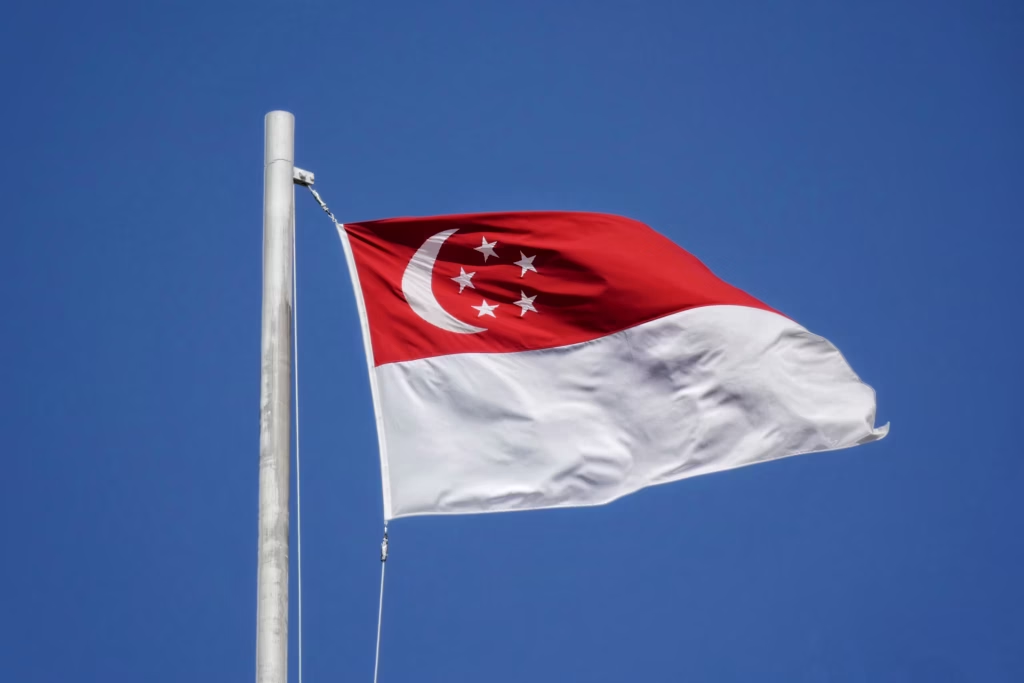
- Singapore and the World Bank Group launched a new programme to strengthen high-integrity carbon markets and help countries access climate finance.
- The initiative will focus on carbon market infrastructure, digital MRV, credit monetisation, national strategies, and host country readiness.
- The programme targets a major barrier in voluntary and compliance markets: weak technical capacity, fragmented registries, and limited buyer confidence.
Singapore Moves To Strengthen Carbon Market Infrastructure
Singapore is deepening its role in global carbon markets through a new partnership with the World Bank Group aimed at helping countries build the systems, policies, and technical capacity needed to participate with integrity.
The Singapore Carbon Markets Programme was launched at the Innovate4Climate conference in Singapore this week. It forms part of the World Bank Group’s strategic partnership with the city-state and adds another layer to Singapore’s carbon market diplomacy.
The programme targets a practical problem facing many countries. Carbon markets can direct climate finance into developing economies, but only when countries have trusted systems, clear rules, and credible data. Without these foundations, project developers face higher risk, buyers hesitate, and host countries struggle to capture value from carbon credit demand.
The Singapore Government and the World Bank Group said the initiative will help countries strengthen technical capabilities, institutional capacity, and digital infrastructure. The aim is to support high-integrity carbon markets that can deliver climate and development outcomes.
Three Priorities For Market Readiness
The programme has three core components.
First, it will focus on carbon market infrastructure and technology. This includes toolkits to help countries develop interoperable carbon registries aligned with international standards. It will also support digital carbon abatement monitoring, reporting, and verification, known as MRV, for new credit types, including regenerative agriculture.
Second, the programme will test new ways to monetise carbon credits. It will pilot methods for aggregating demand and supply at both buyer and country level. The goal is to reduce transaction costs, draw in demand, and lower project risk in underserved markets.
Third, it will support host countries with capacity building and market readiness. This includes help with national carbon market strategies, policy frameworks, institutions, and cross-country learning.
The World Bank Group brings long experience in technical assistance, finance, and development delivery. Singapore brings a policy and market platform shaped by its carbon tax, carbon credit purchase agreements, and growing base of carbon market service providers, exchanges, and market participants.
Singapore introduced a carbon tax in 2019. Since then, it has signed carbon credit purchase agreements with several host countries and worked to position itself as a trusted hub for international carbon market activity.
RELATED ARTICLE: Singapore and Chile Sign Carbon Credit Agreement Under Paris Agreement Article 6
Finance, Trust And Governance At The Centre
The partnership arrives as governments, investors, and corporates face growing pressure to prove that carbon credits deliver real climate value. That has placed new attention on governance, transparency, registry quality, and the treatment of host countries.
Singapore has also taken a wider international role in carbon market cooperation. It co-leads the Coalition to Grow Carbon Markets with the United Kingdom and Kenya. It is also a founding partner of CAD Trust with the World Bank Group and the International Emissions Trading Association.
Kristina Svensson, East Asia and Pacific Regional Hub Manager, World Bank Group, said “This partnership reflects our commitment to deliver tangible development outcomes by providing meaningful access to climate finance to the countries that need it most. It reinforces our strategic alignment with the Government of Singapore to build high-integrity carbon markets.”
Jamie Fergusson, Director for Climate, World Bank Group, said “Carbon markets can become a source of climate finance for developing countries, but only if countries have the infrastructure, market confidence, and technical capacity to participate with integrity.”

For corporate buyers, the programme points to a more structured market environment. Better registries, digital MRV, and stronger host country systems can reduce integrity risks and improve confidence in credit procurement. For investors and developers, aggregation models may help unlock demand in markets that have struggled to attract finance.
Singapore’s Carbon Market Role Expands
Benedict Chia, Director-General (Climate Change), National Climate Change Secretariat, said “Singapore is committed to advancing high-integrity carbon markets as a key pillar of both global climate action and sustainable development. Our collaboration with the World Bank Group on the Singapore Carbon Markets Programme reflects this commitment. We hope this programme will strengthen confidence in the global carbon market and help ensure that host countries can meaningfully participate in and benefit from it.”
The programme places Singapore at the centre of a policy challenge that now reaches far beyond trading platforms. Carbon markets need trust before they can scale. That means stronger infrastructure, clearer country strategies, and credible systems that connect finance with real emissions reductions.
For developing countries, the stakes are high. If built well, carbon markets can help channel private capital into climate projects and local communities. If built poorly, they risk deepening mistrust and limiting participation. Singapore and the World Bank Group are betting that capacity, governance, and digital infrastructure can close that gap.

The ESG News Editorial Team is comprised of veteran financial journalists and sustainability analysts dedicated to providing real-time, objective reporting on global ESG regulations, climate finance, and corporate governance. Our desk monitors daily developments from the SEC, IFRS, CSRD and international regulatory bodies to ensure our 1M+ readers receive accurate, data-driven insights into the evolving sustainable investment landscape. Follow the ESG News Editorial Team for expert reporting on global sustainability standards, ESG disclosures, and climate policy. Access over 10,000 investigative reports and real-time updates.