International Olympic Committee Achieves Highest Sustainability Standard For Corporate Events
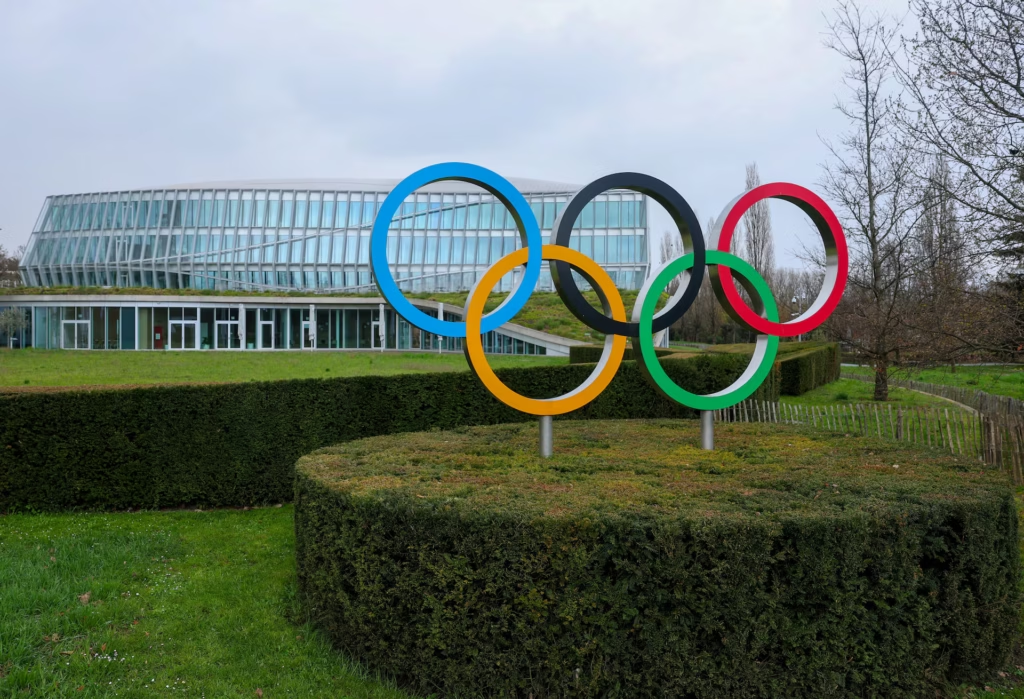
- The IOC has been re-certified to ISO 20121:2024 for corporate events it directly organises and finances.
- The updated standard expands focus to human rights, accessibility, climate action, social impact and legacy.
- The IOC says its corporate carbon footprint fell 30% by the end of 2024, against a 2016 to 2019 baseline.
IOC Raises Event Sustainability Controls
Switzerland, is again placing event sustainability under an international standard as the International Olympic Committee secures re-certification to ISO 20121:2024 for its corporate events.
The updated certification applies to events the IOC organises and finances directly. These include IOC Sessions, commission meetings, Olympic Day events, the International Athletes’ Forum, conferences and other institutional gatherings.
For the Olympic Movement, the re-certification is more than an internal operating update. ISO 20121 is also a requirement for all Organising Committees for the Olympic Games. As a result, the IOC’s own compliance gives it a governance benchmark as it promotes the system across Games hosts, federations and event organisers.
The 2024 version of the standard broadens the lens of event sustainability. It now places greater focus on human rights, accessibility, climate change, social impact and legacy. That matters for large sport bodies, where sustainability risks sit across procurement, venues, travel, labour practices and public accountability.
Carbon, Suppliers And Labour Standards Move Higher Up The Agenda
The IOC said the re-certification reflects progress made since its first certification in 2023. The work focused on three areas: reducing environmental impacts, strengthening supplier selection and monitoring, and increasing attention to labour standards in event delivery.
Event-related emissions remain a core issue. Corporate events often involve travel, logistics, temporary infrastructure, technical production and venue operations. These areas can carry material carbon and resource impacts, even outside the scale of the Olympic Games.
The IOC said the work sits alongside its broader corporate decarbonisation efforts. It reported a 30 per cent reduction in its corporate carbon footprint by the end of 2024, compared with its 2016 to 2019 baseline. The organisation has also committed to a 50 per cent reduction by 2030.
Supplier engagement is another major test. The certification process recognised stronger sustainability practices among suppliers, including recurring partners in look and signage, technical production and temporary construction.
The IOC also pointed to greater scrutiny of labour standards. These include working conditions, health and safety, subcontractor monitoring and access to grievance mechanisms. For executives and investors, that detail is important. Event sustainability is no longer limited to recycling, transport or energy use. It now reaches deeper into social safeguards and supply chain oversight.
IOC Says Certification Creates A Framework For Improvement
“We are proud to have achieved re-certification to the ISO 20121:2024 standard,” said Panos Tzivanidis, IOC Corporate Events and Services Director. “It recognises the progress we have made in reducing emissions linked to our events, strengthening the way we work with suppliers, and giving greater attention to social responsibility in event delivery. It also provides a practical framework for continual improvement, helping us ensure that sustainability considerations are integrated into procurement, operations, stakeholder engagement and event delivery, and that progress can be monitored over time.”
The framework was originally developed as a legacy of the London 2012 Olympic Games. It was designed to help organisations plan and manage events that are environmentally responsible, socially inclusive and economically viable.
RELATED ARTICLE: Nike Teams With Olympic Refuge Foundation
Paris 2024 later helped drive the updated version of the system. The revision expands the standard into areas that have become more central to sustainability governance, including impact and legacy, human rights, climate action and accessibility.
That evolution reflects a broader shift in how major events are judged. Organisers now face rising expectations from governments, sponsors, athletes, civil society and local communities. They must show how short-term event delivery aligns with longer-term social and environmental outcomes.
What Executives Should Watch
For C-suite leaders, the IOC’s re-certification points to a wider governance trend. Sustainability systems are becoming more operational, measurable and supplier-focused. They are also moving into areas that boards increasingly track, including human rights due diligence, procurement controls and emissions management.
For investors and partners, the message is also practical. Major sports and entertainment events are high-visibility platforms. Weak sustainability controls can create reputational, regulatory and commercial risk. Stronger standards can help reduce that exposure, especially when they include monitoring and grievance channels.
The IOC said it will continue promoting ISO 20121:2024 across the Olympic Movement. That includes the Olympic Games, International Sports Federations, National Federations and event organisers.
As climate, labour and accessibility expectations rise, the standard gives sport a more structured operating model. Its influence now extends beyond the IOC’s own meeting rooms and into the global business of major events.

The ESG News Editorial Team is comprised of veteran financial journalists and sustainability analysts dedicated to providing real-time, objective reporting on global ESG regulations, climate finance, and corporate governance. Our desk monitors daily developments from the SEC, IFRS, CSRD and international regulatory bodies to ensure our 1M+ readers receive accurate, data-driven insights into the evolving sustainable investment landscape. Follow the ESG News Editorial Team for expert reporting on global sustainability standards, ESG disclosures, and climate policy. Access over 10,000 investigative reports and real-time updates.