Air Liquide Launches Industrial Scale CO2 Capture Pilot to Decarbonize Cement Production
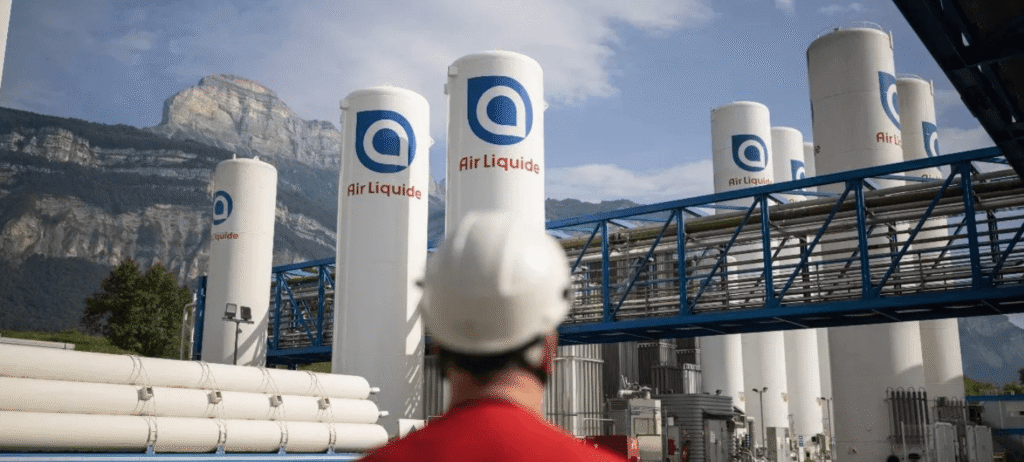
- Air Liquide has started its first industrial-scale Cryocap™ pilot unit designed specifically for cement sector decarbonization.
- The unit can process 3,000 Nm³/h of flue gas and remove impurities before final CO₂ purification.
- The pilot is located at Holcim’s CaptureLab in France, the world’s first cement industry carbon capture test platform.
Air Liquide Targets Cement’s Hardest Emissions Challenge
France, one of Europe’s key industrial decarbonization hubs, is now hosting a new carbon capture test for one of the world’s most difficult sectors to clean up.
Air Liquide has started its first industrial-scale pilot unit designed specifically for cement production. The unit uses the company’s proprietary Cryocap™ technology and is located at Holcim’s CaptureLab in France.
The project brings carbon capture closer to large-scale use in cement, a sector under rising pressure from regulators, investors, and customers. Cement remains central to global infrastructure. It is also carbon intensive by design.
Unlike many industrial sectors, cement cannot decarbonize through clean power alone. A large share of its emissions comes from the chemical breakdown of limestone during production. That makes carbon capture a core technology option, not just a supporting tool.
Cryocap™ FG Focuses on Flue Gas Treatment
The pilot uses Cryocap™ FG, a flue gas version of Air Liquide’s Cryocap™ technology. The system was designed for cement plants, where flue gas treatment remains a major technical hurdle.
The unit can process 3,000 Nm³/h of flue gas. It removes impurities and preconcentrates CO₂ before final purification.
That step matters for commercial deployment. Cement plant flue gas can contain particles, moisture, and other contaminants. These impurities can affect the reliability and cost of carbon capture systems.
By testing pre-treatment at industrial scale, Air Liquide aims to prove that the technology can work under real cement production conditions. It also gives the company a stronger technical base for future cement and lime projects.
The unit follows a modular design. Air Liquide said this allows easy transport and installation. After its first phase at Holcim’s CaptureLab, the pilot can move to other industrial sites.
That mobility could help accelerate testing across different plant configurations. It may also reduce the risk for future customers assessing carbon capture investments.
CaptureLab Gives Industry a Testing Ground
Holcim’s CaptureLab is described as the world’s first capture test platform for the cement industry. Its role is important for a sector where scaling technology remains a major barrier.
Carbon capture projects require more than equipment. They need permitting, integration with plant operations, CO₂ transport options, storage or utilization routes, and long-term policy support.
RELATED ARTICLE: Air Liquide opens liquid hydrogen facility in Nevada
For executives, that makes pilot projects strategically relevant. They test whether technology can move from lab performance to bankable infrastructure.
Air Liquide’s pilot builds on more than a decade of industrial experience with Cryocap™ H₂ at Port-Jérôme in France. That history gives the company a reference point as it adapts the technology for cement and lime.
The next challenge is cost. Carbon capture in cement will need industrial buyers, public incentives, carbon pricing, or regulated demand for low-carbon building materials. Without those market signals, technical progress may not translate into rapid deployment.
Executive Quote
Armelle Levieux, member of Air Liquide’s Executive Committee, notably supervising Innovation and Technology activities, stated: “We are proud to commission this industrial-scale pilot at Holcim’s CaptureLab, a project that marks a significant step forward in the decarbonization of the broader cement industry. This new pilot unit highlights Air Liquide’s leadership in innovation and our unique ability to scale proprietary technologies from laboratory research to industrial-scale applications, providing impactful solutions for our customers.”

What Leaders Should Watch
For cement producers, the pilot offers a signal that carbon capture is moving into more practical testing environments. That matters as companies face pressure to align capital plans with climate targets.
For investors, the project adds to a growing pipeline of industrial decarbonization technologies. The key question is whether policy and infrastructure can keep pace with engineering.
For policymakers, the pilot reinforces the need for enabling frameworks. Cement decarbonization will require CO₂ networks, storage access, low-carbon procurement standards, and clear rules for emissions accounting.
The regional significance is also clear. Europe is trying to protect industrial competitiveness while cutting emissions from heavy industry. Cement sits at the center of that challenge.
Air Liquide’s pilot will not decarbonize cement on its own. But it tests a technology pathway that could become central to the sector’s transition.
If proven at scale, Cryocap™ FG could help cement producers cut process emissions that efficiency gains and renewable power cannot remove. That would give heavy industry a more credible route to climate alignment.

The ESG News Editorial Team is comprised of veteran financial journalists and sustainability analysts dedicated to providing real-time, objective reporting on global ESG regulations, climate finance, and corporate governance. Our desk monitors daily developments from the SEC, IFRS, CSRD and international regulatory bodies to ensure our 1M+ readers receive accurate, data-driven insights into the evolving sustainable investment landscape. Follow the ESG News Editorial Team for expert reporting on global sustainability standards, ESG disclosures, and climate policy. Access over 10,000 investigative reports and real-time updates.